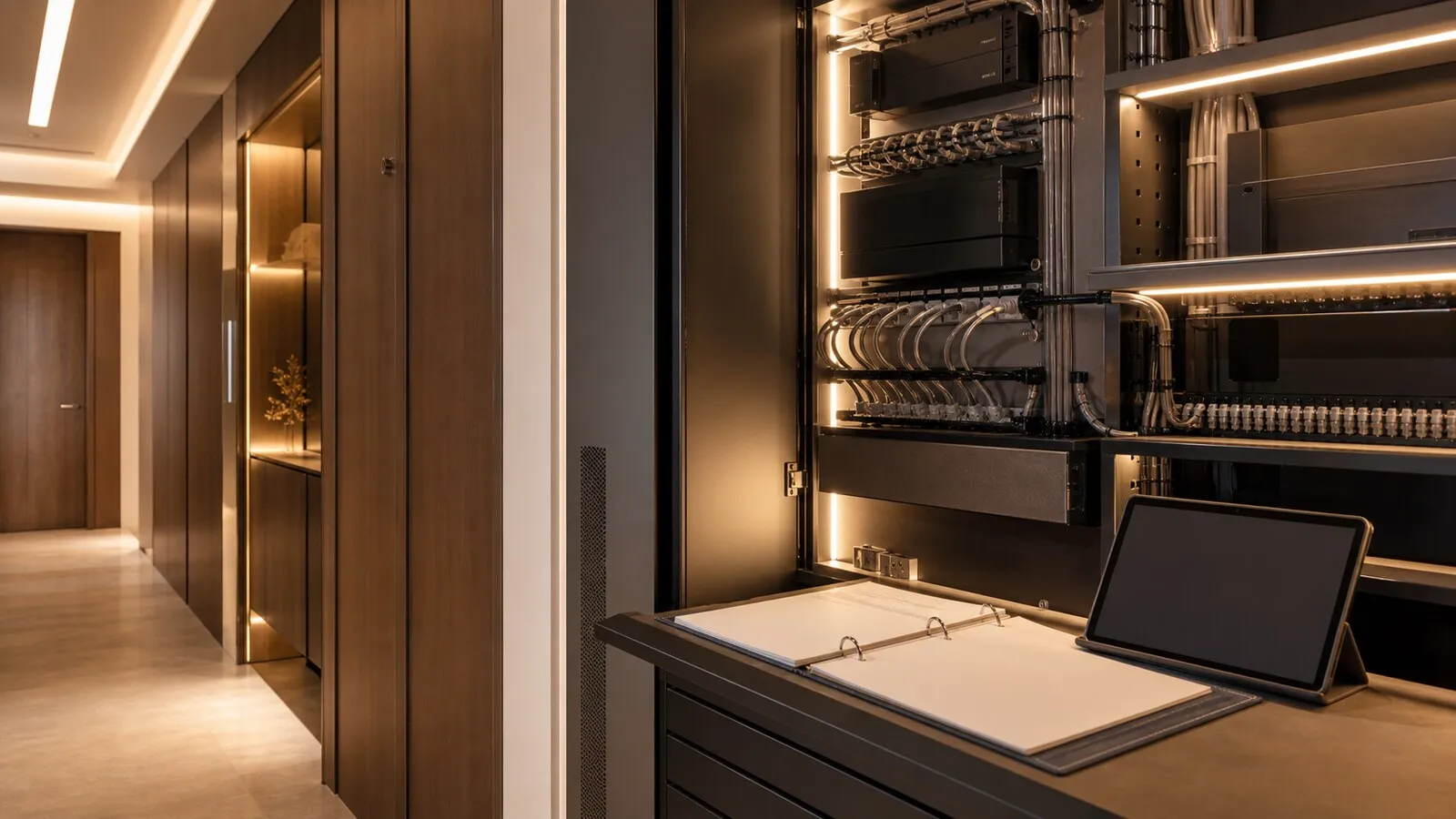
A smart home that is handed over properly is not only a home that works on commissioning day. It is a home that can be understood, maintained, updated and supported over time. The difference between a premium integrated system and a collection of connected devices becomes clear after handover, when users, apps, firmware, suppliers, habits and priorities change.
For international owners of Italian properties, documentation is even more important. The owner may be abroad when support is needed, and the people on site may be staff, a property manager or a local technician. Without technical memory, every intervention starts from uncertainty.
The issue: a handed-over home without technical memory
The final phase of a project is often compressed. Finishes are completed, tests are run, apps and remote controls are handed over, then the site team leaves. If there is no orderly technical dossier, the home remains dependent on the memory of the people who installed it.
Technical memory includes diagrams, versions, credentials, backups, manuals, scene logic, room names, equipment locations and support contacts. Not everything should be given to everyone, but everything should be governed clearly.
The problem grows in homes used by several groups. Family, guests, domestic staff, property managers and technicians have different needs. A professional handover separates the user experience from administrative and technical management.
Technical memory becomes essential when the property changes rhythm. A new staff member, a phone replacement, a network change or a redesigned room can seem minor, but each can affect access, interfaces and automations. Good documentation makes those changes manageable.
Manuals, diagrams and credential ownership
Manuals should be curated. A folder full of generic PDF files rarely helps the owner. The useful material explains the real functions of the property: main scenes, controls, apps, audio, climate, blinds, security, access, basic procedures and support contacts.
Diagrams should match the installed system. Racks, panels, network devices, main equipment, power supplies and connections need labels and documentation. When a technician visits after two years, they should be able to understand the installation without rediscovering it from scratch.
Credentials are sensitive. Account ownership, administrators, temporary users and technical access should be defined. The client should know which accounts they control, which are managed by the service partner and how access can be revoked when roles change.
It is useful to separate the user folder from the technical folder. The first explains everyday functions in plain language; the second stores support, configuration and replacement information. This avoids unnecessary exposure and helps each person find the right material.
Backups, software versions and updates
An automation configuration is a technical asset. Scenes, automations, associations, graphical interfaces and integrations represent project knowledge. Backups should exist, be retrievable and be associated with dates.
Software versions should be recorded at least for the main systems. The home does not need to become an IT laboratory, but it is useful to know which controllers, gateways, apps and critical components are in service. This information supports updates and replacement planning.
Updates are not all the same. Some fix issues, some add features and some require testing. A maintenance process decides when to update, what to verify afterwards and who authorises the intervention.
Support, spares and response times
A smart home needs a support model proportionate to its use. A primary residence, a weekend villa and a property managed by a local team may require different levels of remote access, scheduled visits and response time.
Critical spares should be assessed according to the project. Some components can be replaced quickly; others have lead times or specific configurations. Knowing which devices are central helps define stock, alternatives and priorities.
Response times should also be realistic. Not every issue has the same impact: a lighting scene adjustment, a failed access point and a fault affecting a security system require different priorities. Maintenance works when this hierarchy is agreed before a problem occurs.
Scheduled visits are often more effective than reactive support alone. A periodic check can review backups, rack condition, updates, batteries, active users and scene consistency. The home then remains aligned with real use, not only with the initial configuration.
For owners who visit Italy seasonally, this check is best planned before arrival or after long absence. Small corrections made in advance can prevent the first days in the property from becoming a technical review.
The review cadence can remain light but regular. In a primary residence, a planned check with a short service note may be enough. In a seasonal villa, the system should be reviewed before the owner arrives. In a property managed by third parties, the process should define who opens support tickets and who authorises changes. Documentation should also capture small variations: a renamed scene, a removed user, a replaced remote or a room that has changed purpose. Ordinary details become important after several years of ownership.
Handover and maintenance checklist
- Provide operational manuals specific to the home, not only generic documents.
- Archive diagrams, labels, technical plans and the equipment list.
- Define ownership, administrators and revocation for credentials.
- Keep dated backups of the main configurations.
- Record software versions and an indicative update schedule.
- Agree support channels, priority levels and response expectations.
Elysium treats maintenance as part of the automation project, not as a separate afterthought. Within NvisionGroup, a smart home remains premium when technology stays readable, updateable and supportable long after handover, even when the owner is not in Italy.
Continue reading
Related articles on NvisionGroup:
- Fragile smart homes: mistakes that make a house hard to use
- Control4, KNX and Matter: practical differences for a smart home
- Home automation for luxury villas in Italy: what to design before construction


