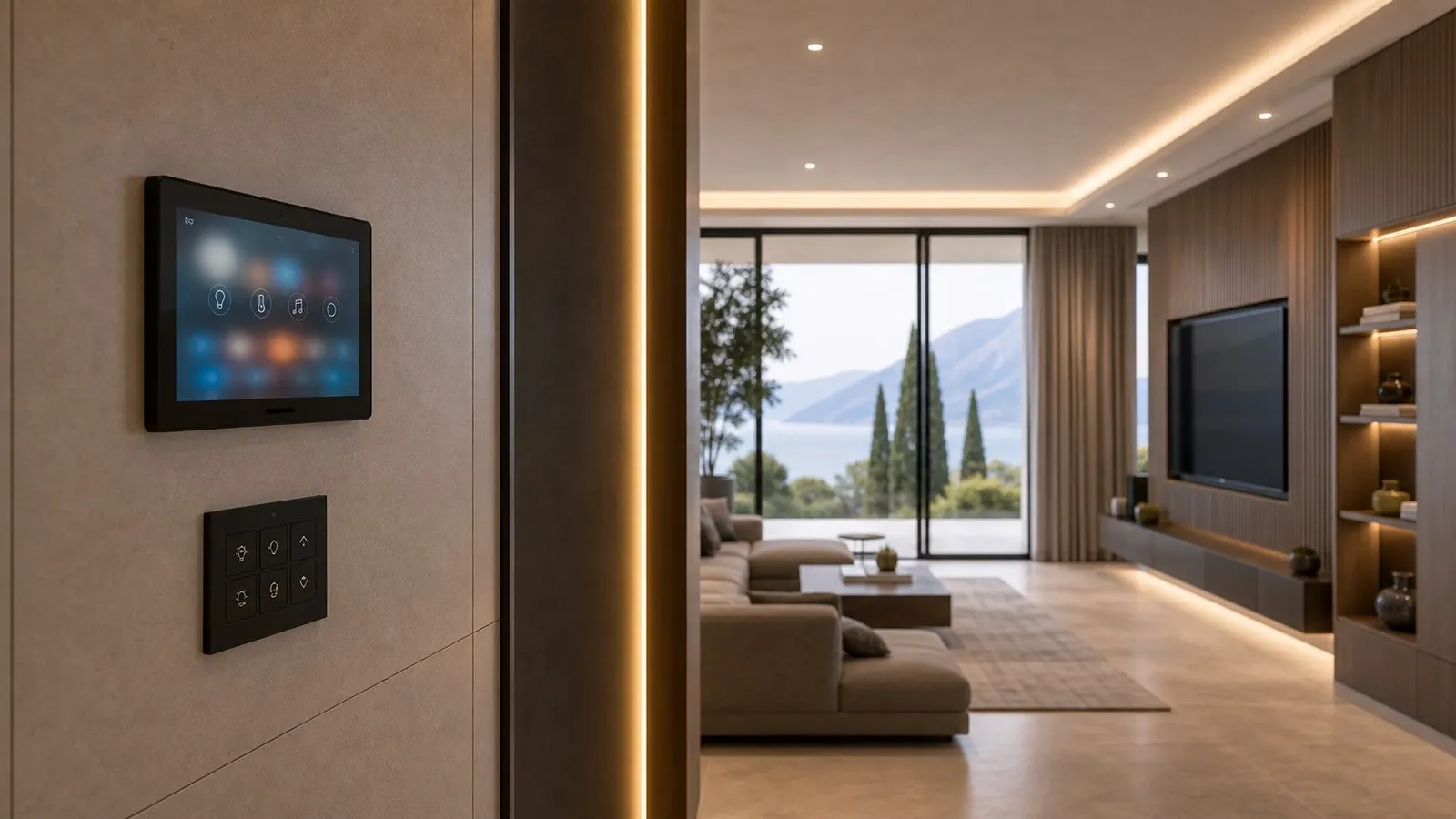
Control4, KNX and Matter are often compared as if they were three versions of the same thing. That creates confusion. KNX is a worldwide standard and professional ecosystem for smart homes and building automation. Control4 is a professional smart home and control ecosystem, often used to orchestrate interfaces, scenes and entertainment. Matter is an open, IP-based smart home protocol intended to improve interoperability between connected devices and major platforms.
For a foreign buyer planning a smart home in Italy, the practical question is not which name sounds most advanced. It is which layer of the house each technology should handle. A premium villa may use more than one of them, provided the roles are clear.
Why comparing different protocols creates confusion
Asking “Control4, KNX or Matter?” mixes infrastructure, control and device interoperability. They are related, but they do not solve the same problem. A villa needs building functions such as lighting, blinds, HVAC and sensors. It also needs user control through keypads, touchscreens, apps, remotes and scenes. It may also include consumer devices such as locks, media products, sensors and voice assistants.
Those layers have different reliability requirements. A decorative lamp can be easy to replace. A gate, security function, main lighting circuit or HVAC zone needs more careful design. Some functions should work locally. Others can depend on cloud services or consumer apps. Some need professional maintenance; others can be owner-managed.
The design task is to assign responsibilities. Without that map, technology choices become brand comparisons and the final system may depend on fragile bridges.
KNX as system infrastructure
KNX is often appropriate for the infrastructure layer. It is a global standard used in smart homes and buildings, with a professional ecosystem of manufacturers, products, tools and trained installers. It does not mean every smart device is KNX compatible; actual device and gateway compatibility must be checked.
In a villa, KNX may handle lighting circuits, dimming, blinds, sensors, room controls, thermostats and interfaces to technical systems. Its value is in structured wiring, distributed logic, professional commissioning and documentation. When designed correctly, many local functions can continue even if internet connectivity is unavailable.
Its limit is also clear. KNX is not the entire user experience, and it is not an audio-video platform. A residence may still need a separate control layer for media rooms, multiroom audio, app design, remote controls and voice integration.
Control4 as AV orchestration and interface
Control4 can be described in general terms as a professional smart home control ecosystem. Its public materials emphasize integrating many smart devices into a unified interface, with smartphones, touchscreens, on-wall keypads and other controls. In practice, systems in this category are often considered when the residence needs coordinated audio-video, scenes and user interfaces.
The important point is role. A control ecosystem can make lighting, blinds, climate, music, home cinema and sources easier to use from one experience. It can also communicate with infrastructure systems such as KNX through appropriate interfaces. But it should not be treated as a substitute for careful electrical design, panel planning or HVAC coordination.
Do not infer commercial status from a technical comparison. Explaining Control4 does not mean a company is an authorized dealer or installer. That must be verified separately for the specific project and market.
Matter and interoperable consumer devices
Matter is designed to improve smart home interoperability. The Connectivity Standards Alliance describes it as IP-based, using familiar network technologies such as Wi-Fi, Thread and Ethernet, with Bluetooth Low Energy used for setup and commissioning. The CSA FAQ also makes a key point: Matter does not replace existing smart home platforms and is supported by most major platform providers.
Matter supports a defined and evolving set of device categories; examples include bridges and controllers, door locks, HVAC controls, lighting and electrical, media devices, safety and security sensors, and window coverings or shades. That is useful, but it is not the same as saying Matter covers every device category or replaces professional integration.
In a premium Italian property, Matter may help with selected consumer devices, future flexibility and cross-platform compatibility. It should not be used as the only strategy for core building systems, security, plant rooms or long-term maintenance.
Checklist for combining them correctly
Use this decision checklist:
- Put critical, wired and long-life building functions on a professional infrastructure layer where appropriate.
- Use a control ecosystem for user experience, AV orchestration, scenes, remotes, touchscreens and app logic.
- Use Matter for supported consumer device categories where interoperability is useful.
- Avoid undocumented bridges for critical functions.
- Require network diagrams, credentials, backups, gateway lists and remote support rules.
- Verify real compatibility of each selected product instead of relying on protocol names.
Elysium starts from responsibilities, not from brand loyalty. A well-designed smart home in Italy can combine infrastructure, control and interoperable devices, but each layer must have a purpose that can be documented, serviced and explained to the owner.
Continue reading
Related articles on NvisionGroup:
- Home automation for luxury villas in Italy: what to design before construction
- KNX for premium smart homes: when it makes sense
- How much does home automation cost in a luxury villa: a guide to real budgets


