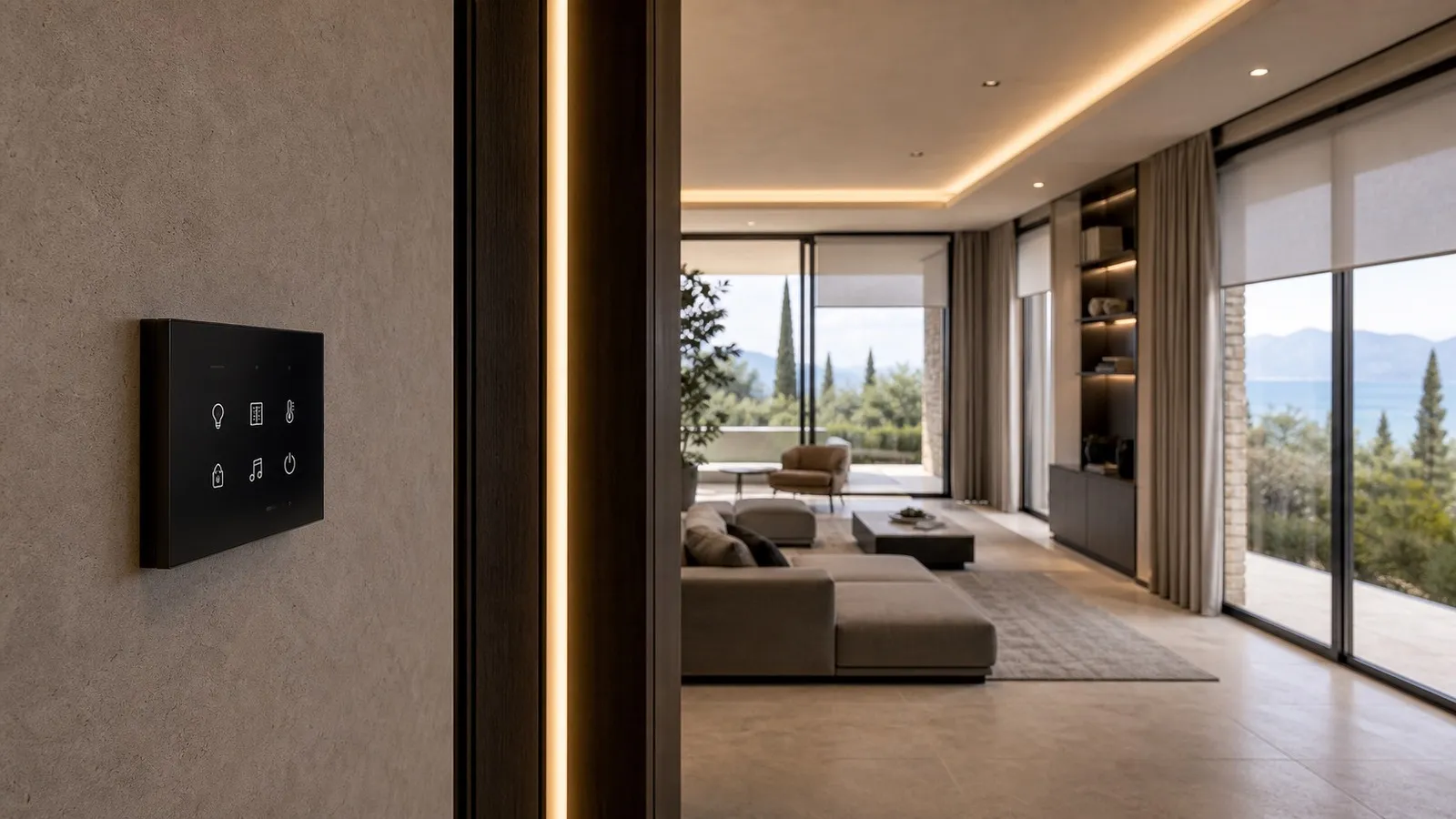
Home automation for a luxury villa in Italy should not be decided after the finishes are ordered. In a substantial residence, automation affects electrical panels, lighting circuits, HVAC zones, blinds, access control, security, Wi-Fi, audio-video, plant rooms and maintenance. If it arrives late, the result is usually a visible compromise: extra wireless devices, duplicated controls, weak coverage and scenes that only partly match the way the house is used.
For foreign buyers building or renovating in Italy, timing is especially important. The project may involve an Italian architect, a general contractor, local electricians, HVAC specialists, window suppliers, lighting designers, interior designers and property managers. Home automation needs to sit between those parties early, while walls, ceilings, conduits and technical rooms are still flexible.
Why automation must be decided before construction
The first decision is not the brand of the app. It is the system architecture. A villa with several floors, guest areas, wellness spaces, garden lighting, gates, shutters and a technical room needs infrastructure: cable routes, panels, network racks, access points, power protection and service access. Every dimmable circuit, motorized blind, sensor, thermostat, speaker and camera needs a physical path and a maintenance strategy.
When those decisions are postponed, the options narrow. The project may rely on radio devices where a wired solution would have been cleaner. Power supplies may be hidden in joinery. Keypads may land in awkward positions because the wall boxes were not coordinated with interiors. Some functions may be excluded because no one allowed for the cable or relay at the right time.
Early design also protects the architecture. A wall keypad should align with stone, timber, switch plates and door geometry. A touchscreen needs depth, power, network and the right viewing height. Motorized blinds need coordination with frames, pockets, tracks and fabrics. The best technology is often discreet because it was designed before the room was finished.
Daily functions and real priorities
The most valuable automation is usually ordinary. Morning, arrival, dinner, guests, night, away mode, cleaning and maintenance are the routines that decide whether the system feels natural. A single “Away” scene can lower selected lights, set climate back, close chosen blinds, arm security functions and notify the property manager. That is more useful than dozens of disconnected features.
Lighting is normally the first layer: dimming, groups, pathway light, exterior scenes and safety levels. Climate control needs to respect real zones, building inertia, sun exposure and the different rhythm of primary homes and second homes. Blinds and shading should balance privacy, heat gain, glare and protection of furnishings. Audio-video should be simple in the rooms where it is used every day, not a collection of remotes and inputs.
Security deserves a separate level of discipline. Intrusion, video surveillance, gates, access control and intercom can be integrated with the smart home interface, but they should not lose their core reliability. Critical systems need clear responsibilities, documentation and service procedures.
Panels, network and predispositions
Good automation is visible in the technical spaces even when the owner never opens them. Electrical panels should have space, labels, service loops, separation between power and signal, protected supplies and room for future changes. A packed panel may work at handover, but it becomes expensive when the owner adds a guest suite, new lighting scenes or outdoor systems.
The network is just as important. Professional Wi-Fi design for an Italian villa is not the same as placing a consumer router near the modem. Stone walls, reinforced concrete, gardens, pool houses and guest buildings can all affect coverage. Switches, cabling, access points, VLANs, outdoor coverage, UPS protection and remote access should be designed as part of the automation project.
Predispositions need real meaning. An empty conduit is not enough unless its route, diameter, destination and purpose are documented. A motorized blind may need power, control cable or an interface depending on the chosen system. A touchscreen may need PoE, a dedicated box or separate power. A future camera point needs network, viewing angle and mounting position, not just a cable somewhere in the ceiling.
Scenes, interfaces and maintenance
Scenes should be named around life in the villa: “Dinner terrace”, “Night ground floor”, “Guest arrival”, “Cinema”, “Away”, “Cleaning”. Each scene should include only the systems that matter. A lighting scene should not unexpectedly change climate. A shading routine should respect wind, access doors and privacy. Automation should feel predictable, not clever for its own sake.
Interfaces need hierarchy. Keypads are for frequent local actions. Touchscreens can show richer functions such as room status, temperatures, blinds, security and audio. Apps are essential for remote supervision, especially for owners who travel, but they should not be the only way to turn on a light. Voice control can help in selected routines, yet physical controls remain important for guests, staff and reliability.
Maintenance should be specified from the start. The owner or property manager should receive system documentation, network information, device lists, backup files, warranty data and support procedures. Permissions should be separated: family, guests, house staff and technicians do not need the same access.
Checklist to start the project
Before construction or renovation begins, confirm these points:
- Define the main routines and the functions that genuinely need automation.
- Decide which systems will be integrated: lighting, climate, blinds, security, gates, AV, irrigation, pool or wellness.
- Design panels, rack, network backbone, access points and power protection with future capacity.
- Coordinate keypads, touchscreens, sensors and controls with finishes, doors, joinery and furniture.
- Identify functions that must work locally even if internet or cloud services are unavailable.
- Prepare documentation, backups, permissions and support responsibilities before handover.
Elysium is most useful when involved at this stage, while the villa can still absorb good technical decisions cleanly. For an international owner in Italy, that early coordination is what turns automation from an expensive add-on into a quiet part of the architecture.
Continue reading
Related articles on NvisionGroup:
- Control4, KNX and Matter: practical differences for a smart home
- KNX for premium smart homes: when it makes sense
- Multiroom audio in a villa: design, zones and network


