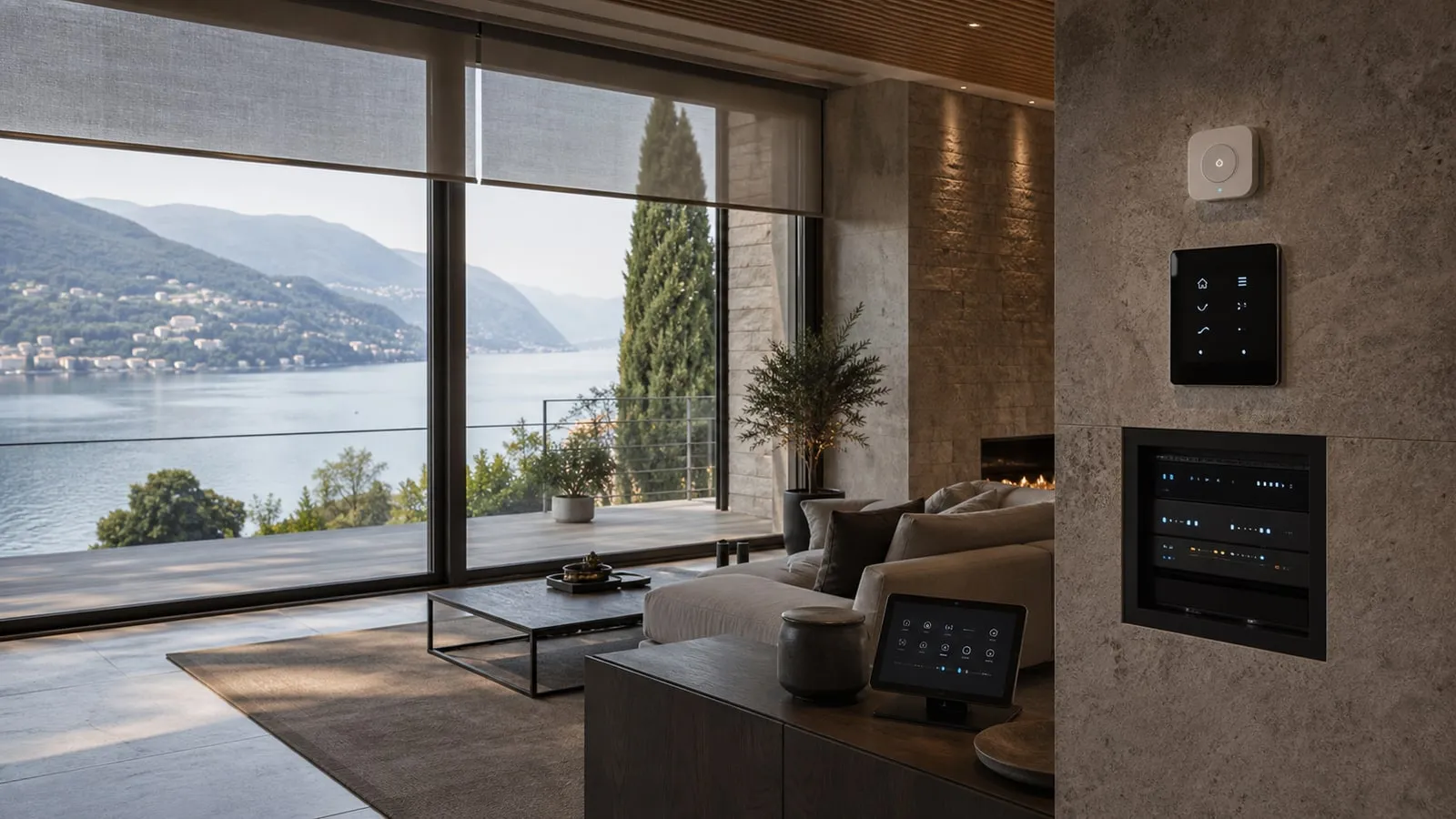
Villas on Lake Como are among the most complex residential projects to work on in Italy. Not because of size — which is often substantial — but because of the combination of three factors that rarely coexist elsewhere: lakeside climate, strict landscape protection, and a highly international clientele, often non-resident, who uses the villa a few weeks a year but expects it to perform as if they were always there.
Automation on Lake Como must be designed with these three realities in mind together. Replicating the same system designed for a Milanese villa or a Sardinian residence eventually leads to problems.
Climate and humidity
Lake Como has high relative humidity for most of the year. Villas often sit close to the water, with cellars, technical rooms or pre-wiring exposed to conditions that wear out electronics faster than in other contexts.
Three practical consequences. The technical rack must be located in a climate-controlled, ventilated room — never in damp cellars or untreated underground spaces. Electrical pre-wiring must use protected materials with appropriate IP ratings. Outdoor speakers, cameras and field devices must be selected with criteria specific to lakeside environments, not generic catalogue products.
All of this translates into project decisions slightly different from those made in the city, but they make the difference between a system that lasts fifteen years and one that needs constant intervention after five.
Remote management of a second home
Many villas on Lake Como are second or third homes belonging to owners who live elsewhere, in Italy or abroad. Automation must therefore play a role that is marginal in the city: managing the villa when no one is there.
This means remote monitoring of systems, alarms for water leaks, frost, fire, intrusion. It means pre-conditioning the villa before arrival, so the owner finds temperature, lighting and atmosphere already set. It means access control for service staff, housekeepers and caretakers, with differentiated permissions and traceable access.
It also means — and this is where many systems fail — the ability to manage the villa from different time zones without calling the integrator every time. An American client who wants to set the temperature the evening before flying out must be able to do it without intermediaries.
Heritage and landscape constraints
Lake Como is one of the most strictly protected landscape areas in Italy. Outdoor pre-wiring, antennas, surveillance cameras, technical cabinets and even cables on private piers are subject to constraints that need to be managed at design stage, not corrected during construction.
In practice this means working with the heritage office for villas of historic value, with the local council for building permits, and choosing products that favour hidden or camouflaged devices over more visible ones. A visible security camera may require permits; the same model recessed and hidden in a niche obtains approval without issue.
The international clientele
The owners of Lake Como villas are largely international. American, British, Middle Eastern, Russian and increasingly Asian. This translates into three recurring requirements on projects.
The first is documentation and interfaces in English, of course, but also the ability to delegate to architects and interior designers working on the project from outside Italy. Technical dialogue with these studios is a specific skill, not a detail.
The second is the demand for technology standards that are recognisable internationally. Systems like Crestron and Lutron, very common in the US and UK, are often preferred over pure KNX, even when KNX would be the technically better choice. Design has to mediate between client expectations and the technical reality of the project.
The third is the level of post-installation service. A client who uses the villa four weeks a year cannot wait two days for an intervention. Automation needs to be paired with service contracts with fast response times, continuous remote monitoring and, where appropriate, on-the-ground presence in the area.
Most requested integrations
On lakeside villas we frequently see the following integrations: very extensive multiroom audio, because the villas are large with many outdoor spaces; advanced access control for service staff and guests; high-end dedicated cinema rooms, even if used only a few times a year; integrated management of piers, outdoor lighting, fountains, lakeside pools; automation extended to guest houses and staff residences; data networks reaching into the grounds, with Wi-Fi coverage of gardens, terraces and private beaches.
Less frequent, proportionally, are requests for smart office or private meeting rooms: Lake Como tends to be used as a holiday residence rather than a work location, even for those who work extensively from home.
The method that works
On Lake Como projects, the method that works best is one in which automation is designed in parallel with architecture, not added later. This means involving the integrator at the early design stages, planning the right technical rooms, defining environmental constraints together with product choices, and setting up from day one the support relationship that will continue over time.
At NvisionGroup, property coordination on the lake is led by GTS Casa, with direct relationships with architectural studios active in the area. Elysium handles automation design with specific attention to lakeside climate and international integrations, Lastech the pre-wiring and infrastructure, Cinema in Casa the dedicated cinema rooms. It is a setup that has allowed us to work with London-, Dubai- and US-based architects on international residences without translating our method.
Continue reading
Related articles on NvisionGroup:
- Cortina and Forte dei Marmi: home automation for premium second homes
- Home automation for Costa Smeralda and Sardinia: climate, constraints, infrastructure
- Home automation for villas and penthouses in Milan: what premium clients look for


