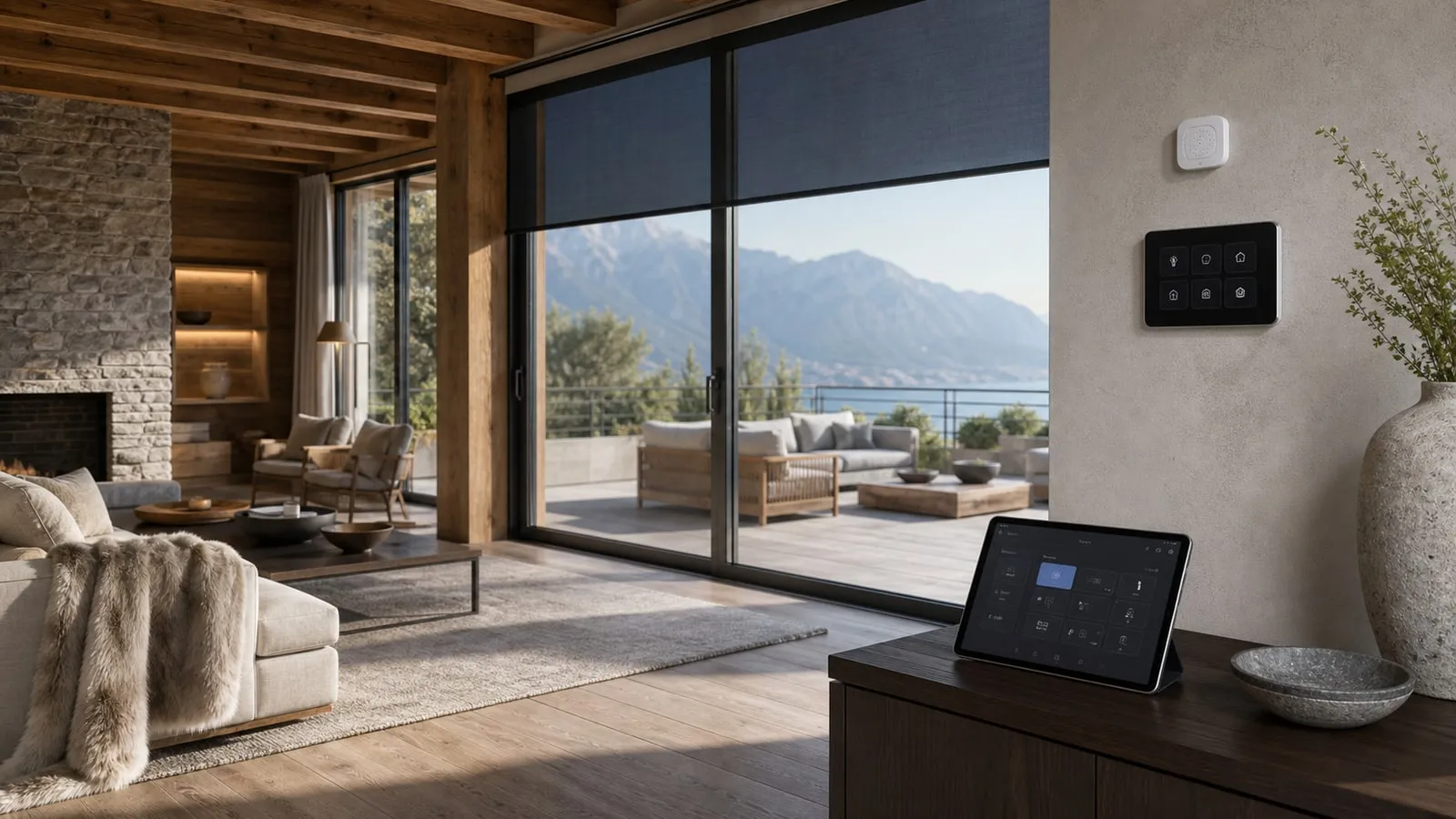
Cortina d’Ampezzo and Forte dei Marmi are the two Italian markets where premium properties are almost always second homes. A client with a villa in Cortina often also owns a house in Forte, in Milan, or both. Automation has to answer a specific need: effective management of homes used for limited periods, in very different contexts, by owners who split their time between several properties.
The two places have very distant architectural languages — Cortina’s alpine timber, Forte’s stone and pinkish tones — but they share similar project factors. It is worth looking at them together, because clients often do.
Cortina: cold, snow, thermal swings
Cortina poses a different technical challenge from almost any other Italian location. Thermal range is wide: in winter, intense cold creates frost risk for plumbing, leaks, exposed batteries. In summer, mountain humidity condenses quickly when air moves into warmer rooms.
Three practical consequences. The automation system must be designed for anti-frost monitoring, with alarms on critical temperatures, leaks, automatic activation of water heaters and radiators during prolonged absence. Outdoor video surveillance requires thermo-stable devices in positions that do not freeze. Technical racks and network cabinets must sit in climate-controlled rooms, never in unheated cellars or attics.
Cortina’s seasonality is also dual: winter (December to March) and summer (July to August). The villa works hard in two periods and stays closed in between. Automation must move from full-occupancy to a custodial mode with pre-conditioning before owners arrive.
Architectural constraints in Cortina
Cortina has strict architectural constraints. The typical pitched-roof villa with timber and stone finishes and traditional balconies is subject to careful building regulations. Every external intervention — antennas, cameras, pre-wiring — must be coordinated with choices coherent with the local architectural language.
In practice this means choosing cameras in finishes consistent with the timber facade, installing outdoor speakers camouflaged into beams or under balconies, avoiding visible technical cabinets or large satellite dishes. All exterior pre-wiring requires design coordination with the architect from the site-visit stage.
Forte dei Marmi: moderate seaside, summer holiday season
Forte dei Marmi is a different market. Salt is present but less aggressive than on Costa Smeralda; wind is less violent; seasonality concentrates between June and September, with intense use over six to eight weeks. Villas are often historic, on the front row or second row from the sea, with garden, pool, terraces and guest houses.
The architectural constraint here is typical of Versilia: facade tones, heights, roof profiles, setbacks, fencing. Outdoor automation must coordinate with architectural choices defined by municipal rules and local tradition. Technical cabinets, racks, outdoor speakers must be selected in coherence with Forte’s language.
Forte dei Marmi’s specificity is intensive summer seasonality. The villa hosts the family, guests, events, outdoor dinners, pool activities. Automation has to handle very high occupancy in a few weeks, with scenes for dinner, party, rest, guest welcome, and then return to custodial mode for the remaining nine months.
Dual residence as a paradigm
Many clients own a villa both in Cortina and in Forte, or pair one of these with a Milanese or international residence. Automation across the two homes must dialogue at the user-logic level. That means: same control interfaces, same scene logic, same app to manage both remotely, same access procedure for service staff.
This is a delicate point. Different systems in the two homes create frustration and underuse. Coherent systems — even with different technical products — make the owner’s life easier and increase the actual use of both villas.
On projects where we have worked on both of a client’s residences, the approach is to keep scenes, controls and logic coherent, even when choosing products and technical architectures specific to each context.
Most requested integrations
In Cortina we frequently see: anti-frost and leak monitoring with remote alarms; integrated management of sauna, spa, gym and other warm spaces typical of alpine homes; access control for winter and summer service staff; pre-conditioning systems active days before arrival; integrated management of fireplaces, stoves and mechanical ventilation.
In Forte dei Marmi we frequently see: very extensive outdoor and poolside multiroom audio; access control for guests and service staff during the season; video surveillance coordinated with local security; pool, irrigation and landscape-lighting management; scenes for dinner, events and welcome coordinated with drapes, lights, audio and climate.
The client who owns both
For a client who owns residences in both Cortina and Forte, automation becomes a service, not a product. They are not interested in the brand of the system, they are interested in it working the same way in both villas, and in having a partner who handles both with continuity.
At NvisionGroup, property coordination for holiday residences is led by GTS Casa. Elysium handles automation design with choices specific to each context, Lastech the pre-wiring and network infrastructure, Cinema in Casa the dedicated cinema rooms when the project calls for one. With multi-residence clients, this method avoids the most common problem: different villas behaving differently, ultimately used poorly because no one remembers anymore how to control what.
Continue reading
Related articles on NvisionGroup:
- Smart home for Lake Como residences: design and specifics
- Home automation for Costa Smeralda and Sardinia: climate, constraints, infrastructure
- Home automation for villas and penthouses in Milan: what premium clients look for


