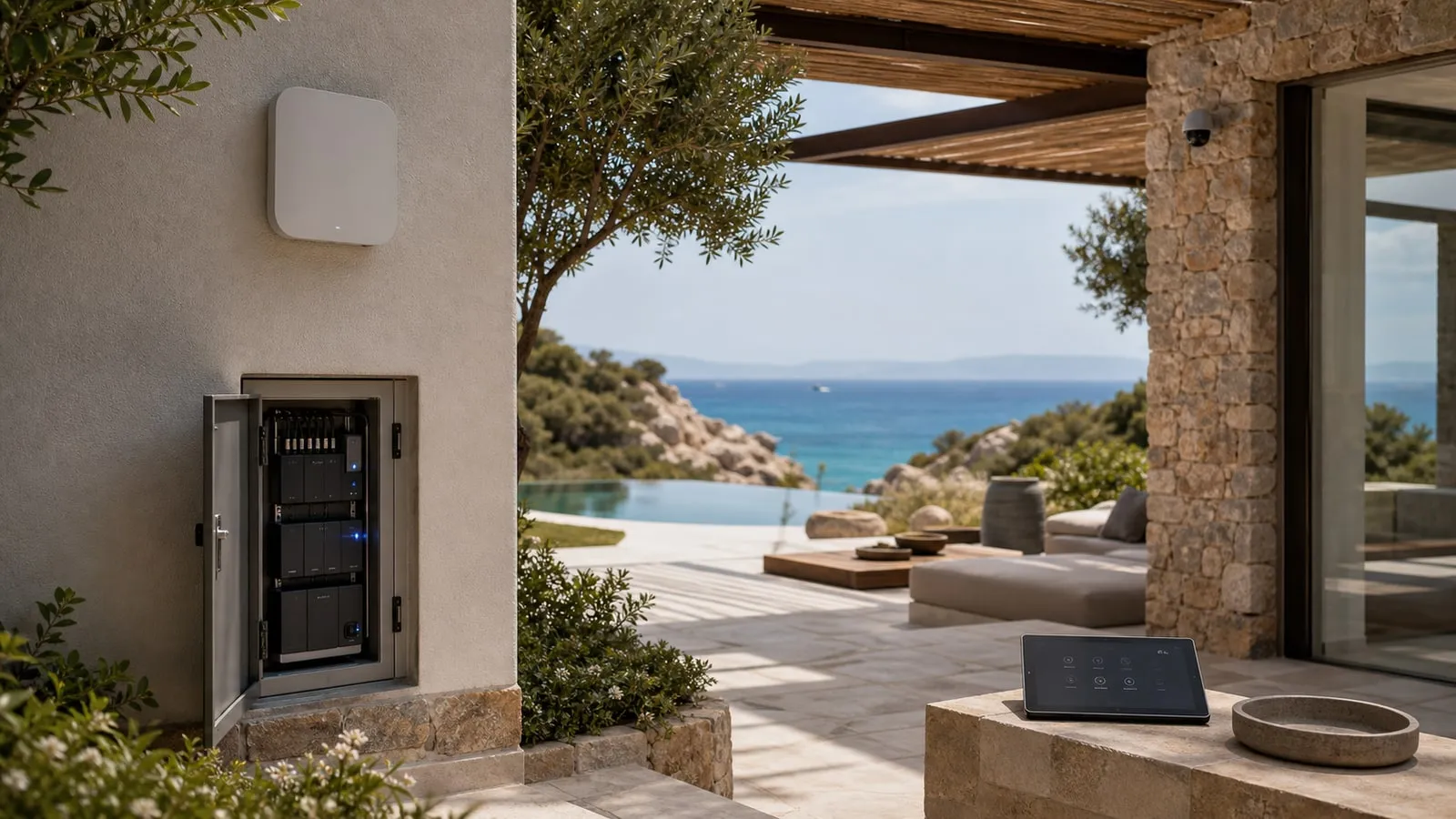
Sardinia is a market of its own for premium residential automation, and Costa Smeralda even more so. Three factors make it different from any other Italian context: an aggressive maritime climate, the heritage constraints of the Aga Khan Architectural Committee, and the infrastructural difficulty that still characterises some areas of the island, even on properties of significant value.
Working well on these projects starts from a premise: you cannot copy a specification designed for Milan, Como or Florence and apply it in Porto Cervo or Stintino. Technical choices, materials, timelines, even the companies involved change. And the difference always shows up sooner or later.
Salt corrosion as the main variable
In Sardinia, salt corrosion is a project variable, not a footnote. It attacks metals, electrical contacts, circuit boards, motors of outdoor blinds, cameras, outdoor speakers. A villa exposed to the maestrale wind, designed without thinking about salt, turns into a permanent service site after three or four years.
In practice this means selecting materials and IP protections that would not be necessary elsewhere. It means designing protected technical rooms with proper ventilation, filters and air exchange. It means having suppliers who manufacture lines specifically for marine environments — not all premium brands do — and making consistent product choices.
Pre-wiring also changes. Exposed cables need adequate sheathing, outdoor electrical panels require dedicated solutions, pre-wiring for pools and beach areas must follow specific criteria. Mistakes at this level are very expensive to correct after handover.
The Costa Smeralda landscape constraints
Costa Smeralda has one of the strictest landscape protection regimes in Italy, managed by the Consorzio Costa Smeralda and its Architectural Committee. The constraints cover materials, colours, heights, profiles, outdoor lighting, even visible antennas and technical cabinets.
In automation terms, this means many decisions must be coordinated from design stage. Surveillance cameras must be selected carefully, because standard solutions may not be approved. Outdoor lighting must respect a precise architectural language, with integrated fixtures and luminance levels in line with Consortium guidelines. Outdoor speakers must be camouflaged in finishes or recessed. Even satellite antennas require dedicated solutions.
None of this is an obstacle, but a project specification. It must be addressed together with the architect and the landscape designer, not separately.
Network and infrastructure
In Sardinia, even on high-value villas, connectivity is never a given. Fibre lines reach some areas, in others coverage is limited or absent. Isolated villas, residences in agricultural or coastal zones far from main centres, can have unstable connections or none at all.
Three consequences. Network design must include redundancy between fibre (where available), professional 4G/5G connections and Starlink. Remote monitoring must work even with unstable connectivity, with buffering and automatic recovery logic. Pre-wiring for the network must be coordinated with the arrival of the main line, whose timing is often unpredictable.
On recent projects, the combination of fibre + Starlink redundancy has become a de facto standard in Costa Smeralda and remote areas, because it ensures service continuity even during outages or work on the main line.
Seasonal use as a paradigm
Sardinian villas are largely second or third homes, used six to eight weeks a year, mostly between June and September. Automation must be designed for two regimes: the lived-in villa, when the system must be responsive, scene-rich, integrated with every daily use; and the closed villa, when the system must monitor, handle alarms, track consumption, maintain correct internal climate, and be immediately operational when the owner arrives.
Pre-conditioning before arrival is particularly important. The owner landing in Olbia on a Friday evening must find the villa with the right temperature, blinds positioned, audio in welcome mode, accesses active for service staff. The system must do all of this autonomously, based on a remote command issued in the morning or an integration with the owner’s calendar.
Most requested integrations
On Sardinian projects we frequently see: very extensive outdoor multiroom audio reaching terraces, beach areas and pool; sophisticated access control for service staff, guests and private events; perimeter video surveillance integrated with local security operators; integrated management of pool, irrigation, fountains, garden landscape lighting; automation for guest houses and staff cottages; pre-wiring for yachts and tenders, with consistent control interfaces.
Less common compared to other markets are dedicated cinema rooms, because the Sardinian villa is a place of outdoor life rather than indoor. When they exist, they are often integrated in the living area and used a few times only.
Logistics and site work
A specificity not to be underestimated. In Sardinia, especially outside the main centres, site logistics are more complex. Material delivery times, availability of specialised local technicians, site access during high season: everything requires more careful planning than on the mainland. Well-managed sites close on time; poorly planned ones can stretch by as much as fifty per cent.
At NvisionGroup, technical coordination in Sardinia is led by Lastech with direct site presence during critical phases, while Elysium handles automation design with marine-specific choices. It is a setup that has allowed us to deliver projects in Costa Smeralda, on the Isola dei Gabbiani and in other parts of Gallura without the typical problems of those who approach Sardinia as “another Milan”.
Continue reading
Related articles on NvisionGroup:
- Cortina and Forte dei Marmi: home automation for premium second homes
- Smart home for Lake Como residences: design and specifics
- Electrical systems and home automation: why they must be designed together


