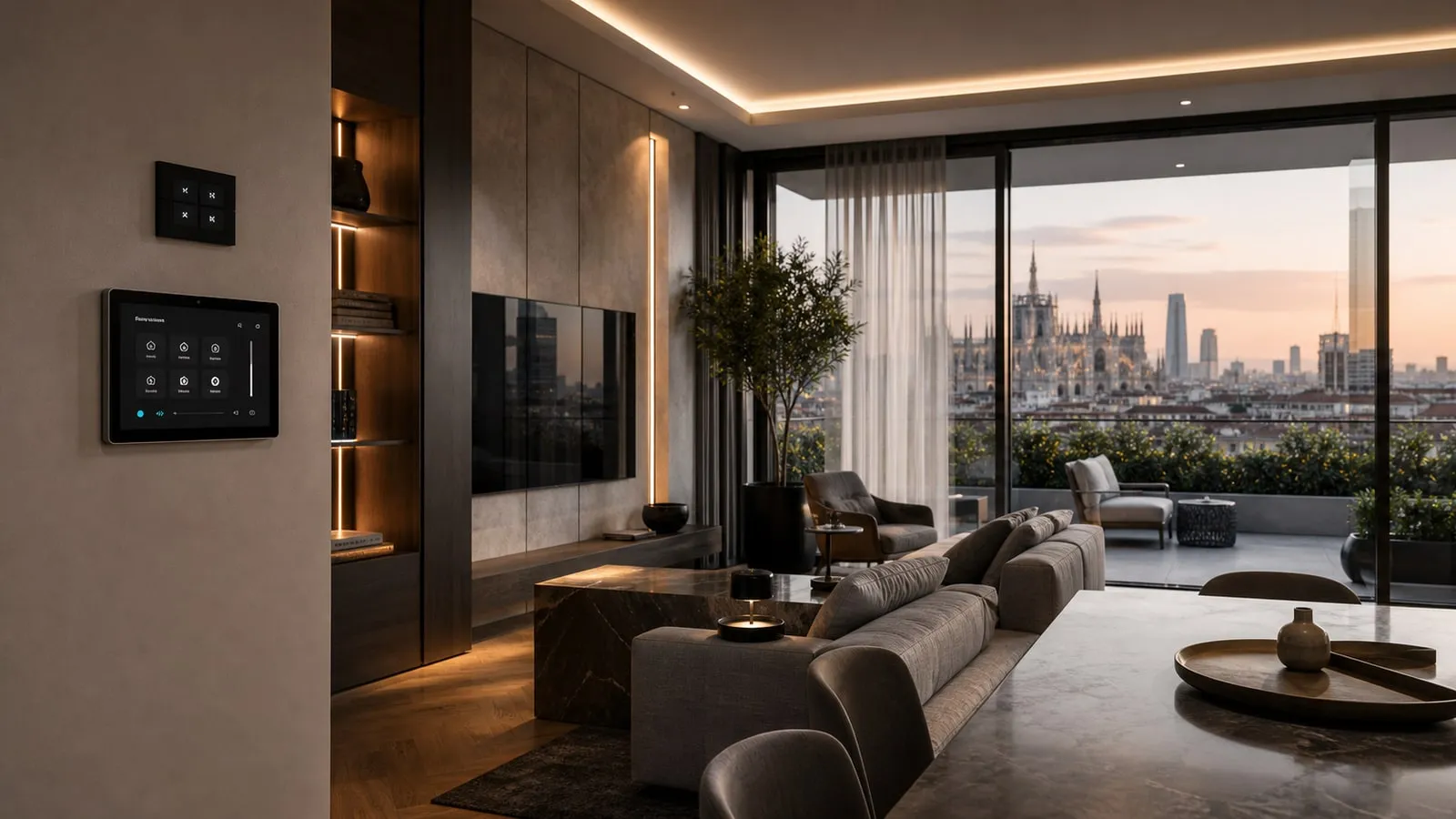
Milan is a market of its own for premium residential automation. It does not behave like Como, like Sardinia, like Forte dei Marmi. The difference is not in budget — which is often comparable or higher — but in the type of property, the urban constraints, the client’s habits and the relationship with the architects and design studios who work on the city.
Understanding these specifics is the first step in designing a system that genuinely works for a Milanese client. Technical choices change, priorities change, even the mix of group companies that take part in the project changes.
The property types we see
In Milan, premium home automation concentrates on four recurring property types.
Penthouses, in areas such as Brera, Magenta, Sempione, San Babila, Porta Venezia and City Life. These are projects where automation has to deal with large glazing, terraces, sometimes rooftop hot tubs or swimming pools, and the question of acoustic comfort in a dense urban setting.
Historic villas with gardens, mostly in premium suburban districts, from southern Lambrate to upper San Siro, from Crescenzago to the Forlanini area, including liberty-era villas and representational homes near the centre. Here automation must dialogue with architectural constraints, valuable finishes, complex systems and, often, the heritage office’s restrictions.
Renovated historic buildings in the centre, where a noble floor or a top-floor flat is turned into a private residence. These are the most technically challenging projects in terms of pre-wiring, because cables and systems must pass without disturbing load-bearing structures or original frescoes.
Contemporary lofts in transforming districts, from Isola to Lambrate, from Bovisa to Dergano. Open spaces that require flexible command solutions and an audio-video distribution consistent with the architectural layout.
What Milanese clients are really looking for
In Milan, the first word that comes up at the kick-off meeting is almost always “discretion”. The system must be there, it must work, but it must not be seen. No plastic touch panels, no bulky keypads, no exposed cables. Milanese automation leans towards minimal interfaces, hidden controls, controls integrated in finishes, invisible automations that make the home easier without looking technological.
The second recurring priority is acoustic comfort towards the outside. Milan is a noisy city even in residential quarters, and requests around motorised drapes, automatically operable windows, noise compensation systems and isolation of technical rooms come up much more often than on other markets.
The third is integration with private lifts and access systems. In many renovated historic buildings, the private lift serving the penthouse or noble floor is part of the residence, and access control needs to be coordinated with home automation and security.
Constraints specific to Milan
Three recurring constraints make Milanese projects different.
Heritage protection on historic buildings. It requires careful choices about pre-wiring, cable routes, command interfaces in frescoed rooms or rooms with original mouldings. It often calls for dedicated solutions that are not in the standard catalogue.
Condominium complexity. In Milan, many premium properties sit inside condominium buildings, even when we are talking about penthouses or noble floors. Some choices — service risers, common technical rooms, antennas, network coverage — must be coordinated with the building management and the condominium rules.
Continuity of use during the works. Many Milanese clients need to keep using the property or face tight delivery windows. Automation design must fit those timelines without creating bottlenecks.
Most requested integrations
On Milanese projects we see the following integrations frequently: scene control for lighting, motorised drapes, HVAC and audio in a coherent way; access control integrated with the private lift; video surveillance dialoguing with condominium systems; pre-wiring for smart office at home, with private meeting rooms equipped for professional video conferencing; cinema rooms integrated in the living area rather than dedicated, due to space constraints.
Less frequent, compared to other markets, are requests for very extensive multiroom audio. In Milanese penthouses, audio zones are often three to five, well curated, rather than the eight to ten typical of lakeside or Sardinian villas.
What a Milanese client truly looks for
The Milanese client tends to look for a partner who understands two things: respect for the home as an architectural object, and the ability to work in coordination with architects, interior designers and construction supervisors who hold high standards. The technical side is taken for granted. The difference is in the method, the documentation, the coordination with the other actors involved.
At NvisionGroup, property coordination in Milan is led by GTS Casa, which works closely with the city’s studios and owners. Elysium handles automation design, Lastech the pre-wiring, Cinema in Casa the dedicated cinema rooms when the project calls for one. It is a setup that works well in Milan because it mirrors how the city operates: each role in its place, with clear direction from start to finish.
Continue reading
Related articles on NvisionGroup:
- Professional Wi-Fi for villas and penthouses: coverage, roaming and stability
- Cortina and Forte dei Marmi: home automation for premium second homes
- Smart home for Lake Como residences: design and specifics


