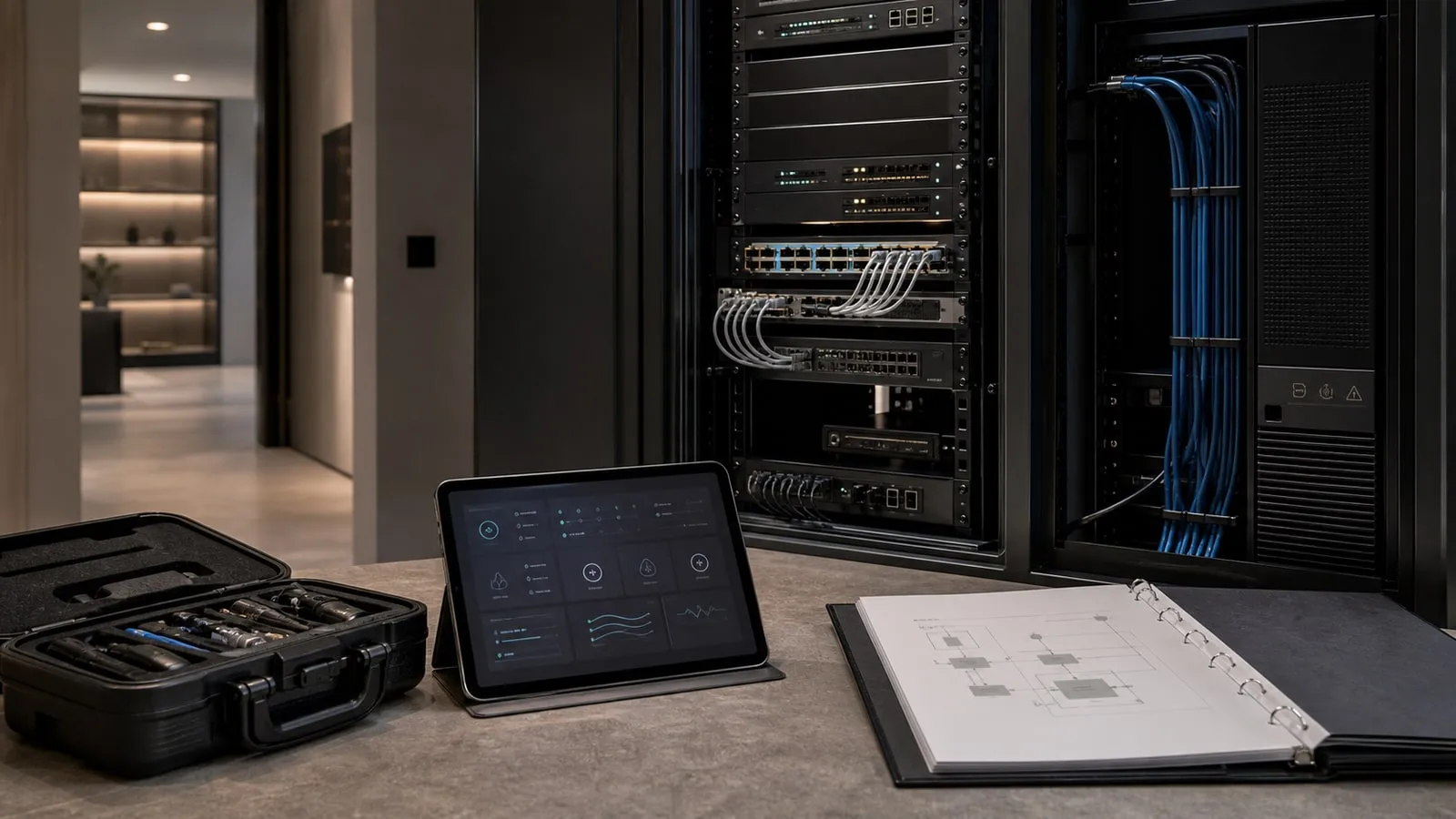
The most underestimated phase of an automation project starts the day after commissioning. When the system is live and the owner begins to use it for real, refinement requests appear, behaviours need adjusting, integrations get added, and in the following months small failures, firmware updates and device replacements come up. This is where a serious integrator shows the difference from any other installer, and where the owner discovers what they actually bought.
On the projects we see fail, the problem is almost never the initial installation. The problem is the post-sale void: nobody picks up the phone, interventions cost unpredictable amounts, passwords are lost, documentation does not exist. It is worth understanding what level of service is reasonable to expect and how to recognise it before signing the contract.
What really happens after handover
A modern home automation system is made of dozens of devices talking to each other: controllers, network switches, sensors, actuators, speakers, cameras, touch panels, app, cloud integrations for remote monitoring. Each part has its own life: updates, possible failures, evolutions, replacements when the manufacturer discontinues the line.
In the first six months the typical requests are about refinement. The owner has used the villa, has understood what works and what to change, wants to add scenes, tweak behaviours, include rooms they had not considered. It is a normal settling phase and it should be planned in the original contract rather than treated as a surprise.
After the first year, request frequency drops. There are periodic maintenance visits, occasional firmware updates, and the odd device replacement. On well-designed systems, maintenance is limited, but it is not zero.
After five to eight years, the more demanding topics begin. Some devices go end-of-life, network standards shift, third-party cloud services shut down. These are phases when a long-term relationship with an integrator becomes irreplaceable.
Typical service contracts
There are three contract levels we see applied on serious projects.
On-demand support. The owner calls when they need help, the integrator intervenes at agreed hourly rates. It works for those who want to pay only when needed, but means longer response times and no prevention. Suitable for owners who use the villa rarely or who have their own technical confidence.
Base subscription. An annual fee covering remote monitoring, a defined number of interventions per year, firmware updates, periodic check-ups. Extraordinary requests are billed hourly. This is the most common level on premium villas, because it balances predictable cost with flexibility.
All-inclusive. A higher fee covering unlimited interventions, active monitoring, continuous remote supervision, device replacements without surcharge. Suitable for owners who use the villa intensively or who want to fully delegate technical management.
The right level depends on the actual use of the villa, the number of residences the client owns and their technical sensitivity. There is no absolute right level, only the right one for that home and that owner.
Remote monitoring: what it has to do
Remote monitoring is the most visible difference between modern and old support. A well-designed system continuously dialogues with the integrator’s monitoring tools, flags anomalies before they become problems, suggests preventive maintenance.
What it must monitor. The state of main devices — controllers, switches, music servers, surveillance NVRs. Network connectivity and the integrity of internal communications. Temperatures in technical rooms, health of power supplies. Anomalous events such as reboots, packet loss, recurring errors. Active alarms for water leaks, frost, intrusion, fire.
What it must show the owner. Monitoring should not turn into a barrage of notifications. It should produce alerts when action is needed, and silence when everything is fine. Low-level information stays with the integrator, who acts silently on the system. The owner only sees what concerns them.
Reasonable response times
On a luxury villa, expected response times differ by urgency.
For emergencies — water leaks, full system blackout, security issues, fire — intervention must be immediate. Serious contracts speak of response within an hour, remote intervention within two, on-site intervention within the day if needed.
For urgent issues — failure of an important device, malfunction of a critical function such as climate or access — response should be within the day, immediate remote intervention and on-site intervention within 24 to 48 hours.
For routine requests — scene changes, small additions, planned replacements — timeframes can run from days to weeks, depending on the agreed schedule.
Slower than this is acceptable only on rarely used homes with no urgency. Faster is possible but comes with higher fees.
Documentation: the real guarantor
Everything described above depends on one thing: the documentation handed over at completion. Without schematics, pre-wiring maps, programming documentation, passwords and credentials, every intervention requires a context reconstruction that costs time and money.
A serious integrator delivers a complete technical folder at handover, in printed and digital form, and commits to keeping it updated with every later change. It is the thing that separates an effective post-sale service from a long ordeal.
It also matters when the integrator changes over time. If the villa changes hands, if the supplier shuts down, if the owner decides to switch maintenance partners, documentation is the only thing that makes continuity possible.
End-of-life of devices
A delicate point. Every device has a lifecycle, and after ten to fifteen years some components go end-of-line. A serious integrator anticipates these situations: flags well in advance when a device is about to be discontinued, proposes compatible alternatives, plans replacements in a coordinated way rather than as emergencies.
This matters especially on central controllers and networking elements, where a poorly planned replacement can mean reprogramming entire scenes. Well-planned, the replacement is invisible to the owner.
At NvisionGroup the post-installation phase is led by Lastech with support from Elysium for the programming side and Cinema in Casa for the cinema rooms. Remote monitoring runs 24/7 on the systems that allow it, documentation is updated with every change, support contracts are structured along the levels described above. It is the level of service we would expect from a supplier if we were on the other side of the table.
Continue reading
Related articles on NvisionGroup:
- Fragile smart homes: mistakes that make a house hard to use
- Access control in a private residence: gates, doors and scenes
- Architect, contractor and technology integrator: avoiding conflicts on site


