Access control in a private residence has to balance three needs: convenience for the people living in the home, governance for the people managing it and consistency with security, intercoms, lighting and automation. It is not only a smarter lock. It is a daily process involving family, guests, staff, suppliers and maintenance teams.
For foreign buyers with homes in Italy, access control is often part of property management. The owner may arrive for short stays, lend the home to family, host guests or coordinate services remotely. A good system makes these situations easier without spreading uncontrolled credentials.
The issue: convenient access without governance
Convenient access becomes weak when it is not governed. If every gate, door or secondary entry has its own logic, the home becomes a sequence of exceptions. The owner has to remember who can enter, staff need informal instructions and technicians depend on personal arrangements.
The first task is to map user profiles: owners, children, relatives, regular guests, domestic staff, gardeners, maintenance teams, deliveries and property managers. Not everyone needs the same entries, the same time windows or the same autonomy. This prevents both unnecessary rigidity and overly broad access.
Simplicity is a technical requirement. If a system requires complicated rituals, people will soon fall back to manual solutions. Rules should therefore be few, clearly named and easy to review.
This is also useful for second homes and properties used irregularly. When the owner is not always present, access cannot depend on improvised calls or credentials shared informally. The process should work on ordinary service days, not only during the carefully supervised handover.
Gates, doors and secondary entries
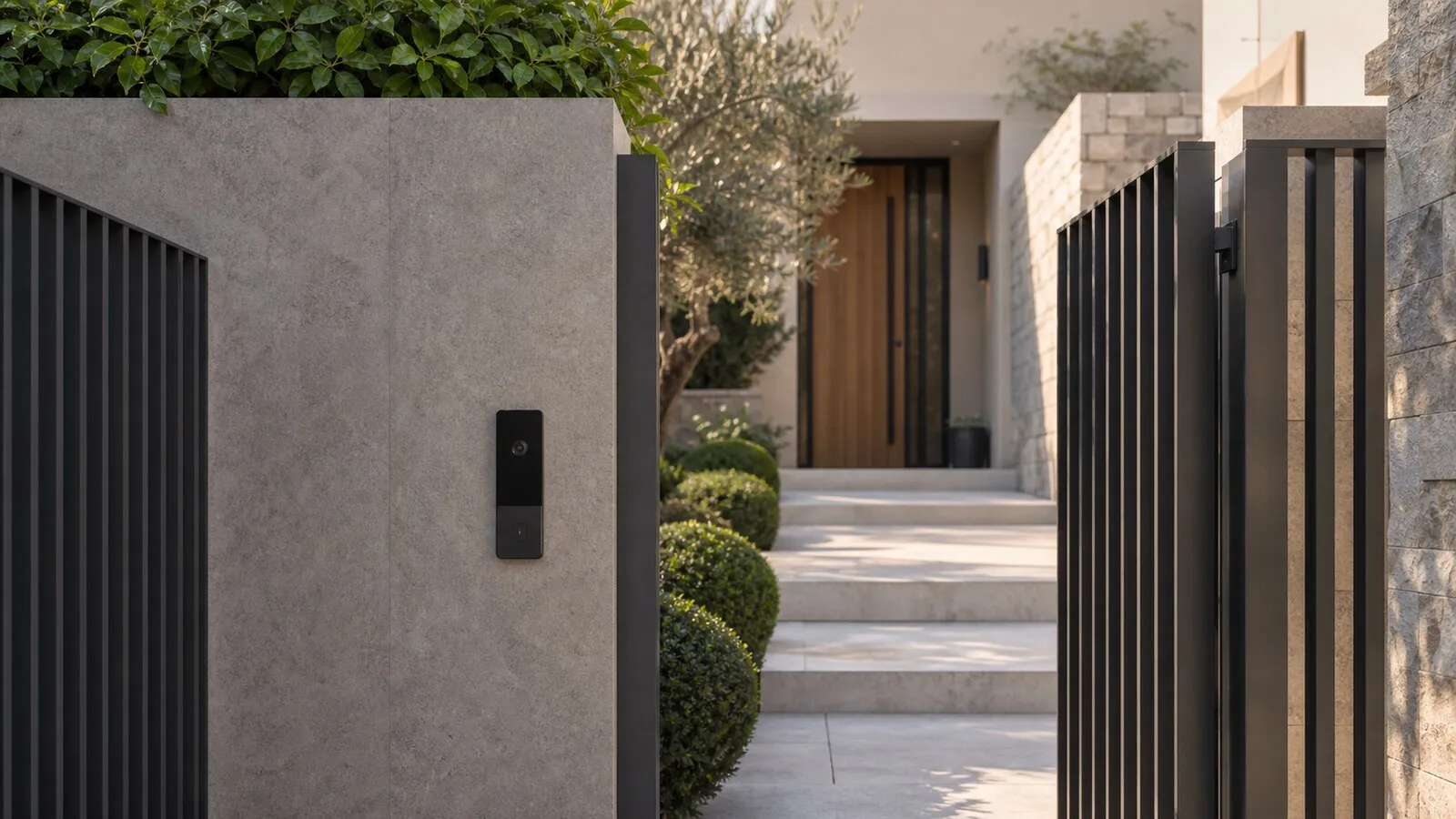
A private residence rarely has one entrance. Vehicle gates, pedestrian gates, main doors, garages, service entries, technical rooms, guest houses and outdoor areas may all have different roles. Designing them together avoids inconsistencies between access control, locks, intercoms, alarms and lighting.
The main entrance should provide a clear experience. Visitors need to know how to call, be recognised and receive authorised opening. Residents should enter without friction while keeping credential management orderly.
Secondary entries deserve attention because they often become permanent exceptions. Technical access, plant rooms and staff entrances should be useful but not invisible from a management point of view. The project should state who uses them and how they are maintained.
Durability in daily use matters too. Outdoor readers, motorised locks, gates and video intercoms should be selected with maintenance, spare parts and replacement in mind. Access control proves its quality when it still feels natural after several seasons of use.
Credentials, guests and time windows
Credentials may include physical keys, codes, badges, smartphones, remote controls and digital profiles. Each technology has advantages and limits. The right choice depends on user age, guest frequency, staff presence, support model and desired level of control.
Guests require a specific logic. A family may host friends for a weekend; a villa managed from abroad may need property managers, cleaning staff and suppliers. In both cases, temporary access should be easy to create, explain and revoke.
Time windows are useful only when they remain understandable. Too many rules create mistakes; a small number of documented rules makes the system manageable. A simple matrix of profiles and entries is often more valuable than a complex configuration nobody reviews.
Scenes with lights, alarm and video intercom
Access control naturally connects with other systems. Opening a gate may trigger path lighting, an intercom workflow, an alert or a security state. These integrations should be proportionate and verifiable.
The home should not run ambitious sequences without knowing the context. A maintenance visit is different from the owner’s arrival; an evening guest is different from a supplier. Scenes should recognise practical differences without becoming fragile.
Documentation matters. Anyone changing an access profile should know whether that change affects lights, alarms, notifications or intercom behaviour. Integrated access control is powerful when it remains readable.
Handover should include tests with real cases: owner arrival, temporary guest, supplier, maintenance visit and service entry. These tests expose ambiguity before it becomes a bad habit in the way the property is managed.
For an owner based outside Italy, these tests should also confirm who can act locally when plans change at short notice. The system should support normal life, including delayed flights, unexpected guests and urgent service visits.
The design questions are simple but important. Who creates temporary access? Who approves it? How long does it remain active? What happens when domestic staff changes or a maintenance contract ends? Who holds physical fallback keys, and who updates the profile matrix? Answering these questions does not make the system complicated; it prevents convenience from depending on informal arrangements. A premium residence should have a light operating record, updated when people, apps, phones or usage patterns change.
That record should be understandable to a new local contact without relying on scattered messages.
Checklist for managing access
- List every entry, including technical and secondary ones.
- Define user profiles with proportionate permissions.
- Establish procedures for guests, staff and maintenance teams.
- Coordinate access control with intercoms, lighting and alarm states.
- Plan periodic credential review and revocation.
- Handover an updated matrix of entries, profiles and responsibilities.
Lastech treats access control as part of the daily life of the residence. In NvisionGroup projects, the technology works when entrances become easier to use and clearer to administer, especially for owners coordinating an Italian property from abroad.
Continue reading
Related articles on NvisionGroup:
- Intrusion systems for smart villas: integration without fragile automation
- Network, security and resilience: the invisible base of a smart home
- Smart home predispositions: what to decide before walls are closed


