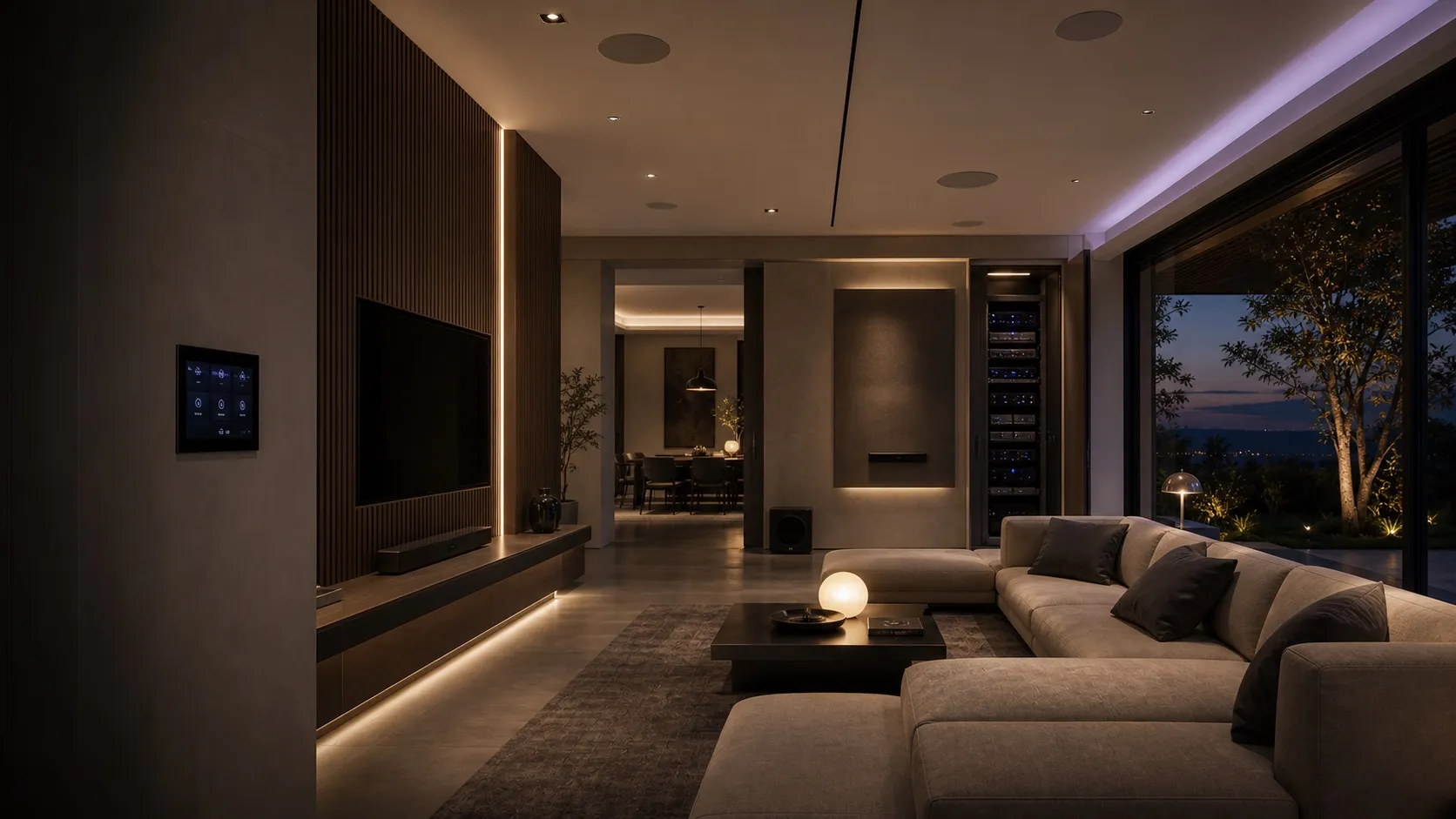
Twenty years ago, when we designed the first private cinema room in Italy, multiroom audio was a chain of amplifiers connected by metres of cable. Today, a three-hundred-square-metre apartment is controlled by an app — but the complexity hasn’t gone away; it has just moved elsewhere.
From analogue to distributed
For years, the dominant model was centralised: a technical rack in the systems room, dozens of shielded cables crossing walls, one single brain from which everything originated. It worked, but it was fragile. A failure in the rack brought the whole system to its knees; any later addition — a zone, a source, a speaker — meant going back into the wiring.
The turning point didn’t come from hardware, but from the protocol. When network streamers learned to speak the same language, it became possible to distribute intelligence instead of concentrating it. Every zone today has its own small computer, and the network handles the rest.
The future of audio is not in any box. It’s in the network that connects them — and in the software that makes them disappear.
What changes on site
The practical consequence is significant: fewer cables, more network. Our Lastech infrastructure today specifies a Cat 6A backbone in every inhabited room; shielded audio cabling has become the exception, not the standard. Three main benefits:
- Expandability. Adding a zone is a matter of a switch and an app, not chasing walls.
- Resilience. A node failure does not bring the system down; at worst, it silences one room.
- Upgradability. Audio quality grows with the firmware, not only with the hardware.
A concrete case
In the villa on Lake Garda delivered in March, the audio system covers nine zones — from the living room to the pool area, including a dedicated cinema room. None of them is physically connected to the others: each has its own streamer, its own pair of speakers, its own network connection. Yet the owner can pick what they’re listening to in the kitchen and take it poolside with a single gesture.
The invisible part — the one we consider the real project — is in the synchronisation: eighty milliseconds of drift between zones, below the threshold of perception. To get there, we spent six months on calibration, both on site and in the lab.
What remains to do
The direction is set, but the technical work continues. The next frontier is audio quality in transition spaces — corridors, stairs, entrances — where reverberation plays nasty tricks. We’re experimenting with adaptive directionality configurations. More on that soon.
Continue reading
Related articles on NvisionGroup:
- Control4, KNX and Matter: practical differences for a smart home
- Fragile smart homes: mistakes that make a house hard to use
- Home automation for luxury villas in Italy: what to design before construction


