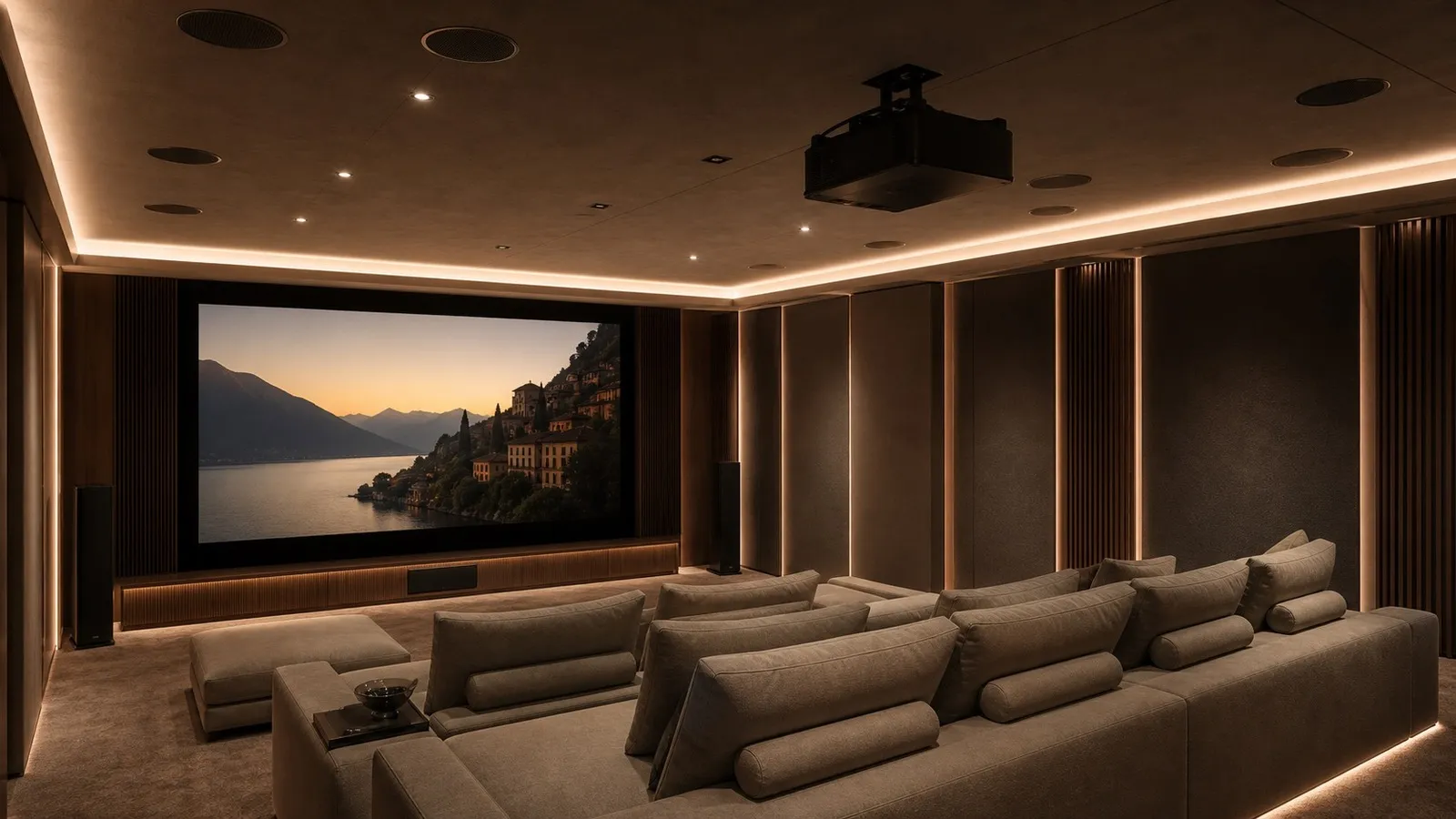
A Dolby Atmos 7.2.4 home theater sounds like a precise specification, but the number alone does not design the room. It describes a speaker layout: seven ear-level channels, two subwoofers and four height channels. It does not say whether the room can support that geometry, whether the main seats are in the right place or whether the ceiling can create a convincing overhead field.
In Dolby layouts such as 5.1.2 or 7.1.4, the first number refers to ear-level speakers, the second to subwoofers and the third to height speakers. A 7.2.4 system is therefore ambitious, but it still needs to be translated into the real architecture of the home.
The issue: channel counts without a room design
The most common mistake is to start with “more channels” rather than with the room. Dolby’s own setup guidance is clear that there is no one-size-fits-all home theater layout. Room size and shape, seating, screen, speakers, lighting and acoustics all matter.
The main listening position should face the screen directly and, where practical, sit close to the centerline. This point becomes the reference for screen size, speaker angles, subwoofer testing, lighting and calibration. If the main seat is too close to the rear wall, far off axis or under a very low ceiling, a larger channel count will not automatically solve the compromise.
For international owners designing a cinema room in Italy, this is especially relevant during renovation. Historic masonry, concrete slabs, beams, vaults or planning constraints may limit what can be placed in walls and ceilings. The best layout is the one the room can actually support.
This also affects procurement. Equipment can usually be changed later; speaker locations, conduit paths, ceiling build-ups and acoustic layers are far harder to change once Italian site works move into finishes.
Bed layer, surround and height speakers
The seven ear-level channels create the front stage, side surround and rear surround field. The front speakers anchor dialogue and action to the screen. Surrounds create envelopment without drawing attention to themselves. Rear surrounds complete the sound field when there is enough space behind the listener.
Dolby describes speaker setup through the triangle and sweet-spot principle. In a real project, that means the seat is not an afterthought. Speaker positions, wall finishes and seating rows should be coordinated before construction details are closed.
Height speakers create the vertical dimension of Atmos. Dolby Atmos can use ceiling speakers or upward-firing speakers to produce overhead and spatial effects. In a dedicated premium room, ceiling or integrated overhead speakers are often more controllable, but the right choice depends on ceiling height, structure, finish, access and the room’s acoustic behavior.
Subwoofer quantity and placement
The “.2” in 7.2.4 does not simply mean more bass. Two subwoofers are usually used to distribute low frequencies more evenly across seats and reduce large differences between listening positions. Poorly placed subwoofers can still create peaks, cancellations and uneven impact.
Placement depends on the room. Corners, risers, niches, masonry walls, furniture and openings all affect the bass response. In a villa or apartment, isolation also matters because low-frequency energy is the part most likely to travel through structure and disturb other rooms.
For this reason, subwoofer positions should be testable rather than chosen only for symmetry. The design should allow cable routes and power where testing suggests the best result, not only where the joinery looks easiest.
Amplification, calibration and control
A 7.2.4 system needs suitable electronics: processor or AV receiver support, adequate amplification, correct cabling, reliable network infrastructure and a well-ventilated rack. A premium cinema room should not depend on improvised connections behind a cabinet.
Calibration is not a final formality. Dolby notes that calibration and room correction can help optimize a setup. They are useful, but they do not replace good placement, acoustic planning and real listening checks after seats, curtains and finishes are installed.
Control is part of the system design. Starting a film should coordinate source, display or projector, processor, lighting and climate with simple commands. If the room is complicated to use, it will be used less, regardless of the equipment list.
Checklist for a coherent layout
Before committing to 7.2.4, confirm:
- The main seat can face the screen directly and stay close to centerline.
- The room has enough width and depth for seven ear-level channels.
- The ceiling can support four height channels or another Atmos approach.
- Two subwoofer locations can be tested and serviced.
- Walls, doors and structure can handle the expected low-frequency energy.
- Rack, cooling, power and cabling are sized for the complete system.
- Calibration is planned after final seating, curtains and finishes are in place.
Cinema in Casa uses these questions before recommending a layout. A 7.2.4 room can be excellent, but only when the property, construction details and listening geometry make it a coherent choice.
Continue reading
Related articles on NvisionGroup:
- Private cinema room in an Italian villa: how to design it properly
- Dedicated cinema room or living-room home theater: how to choose
- Sound isolation for a private cinema room: what to assess before work starts


