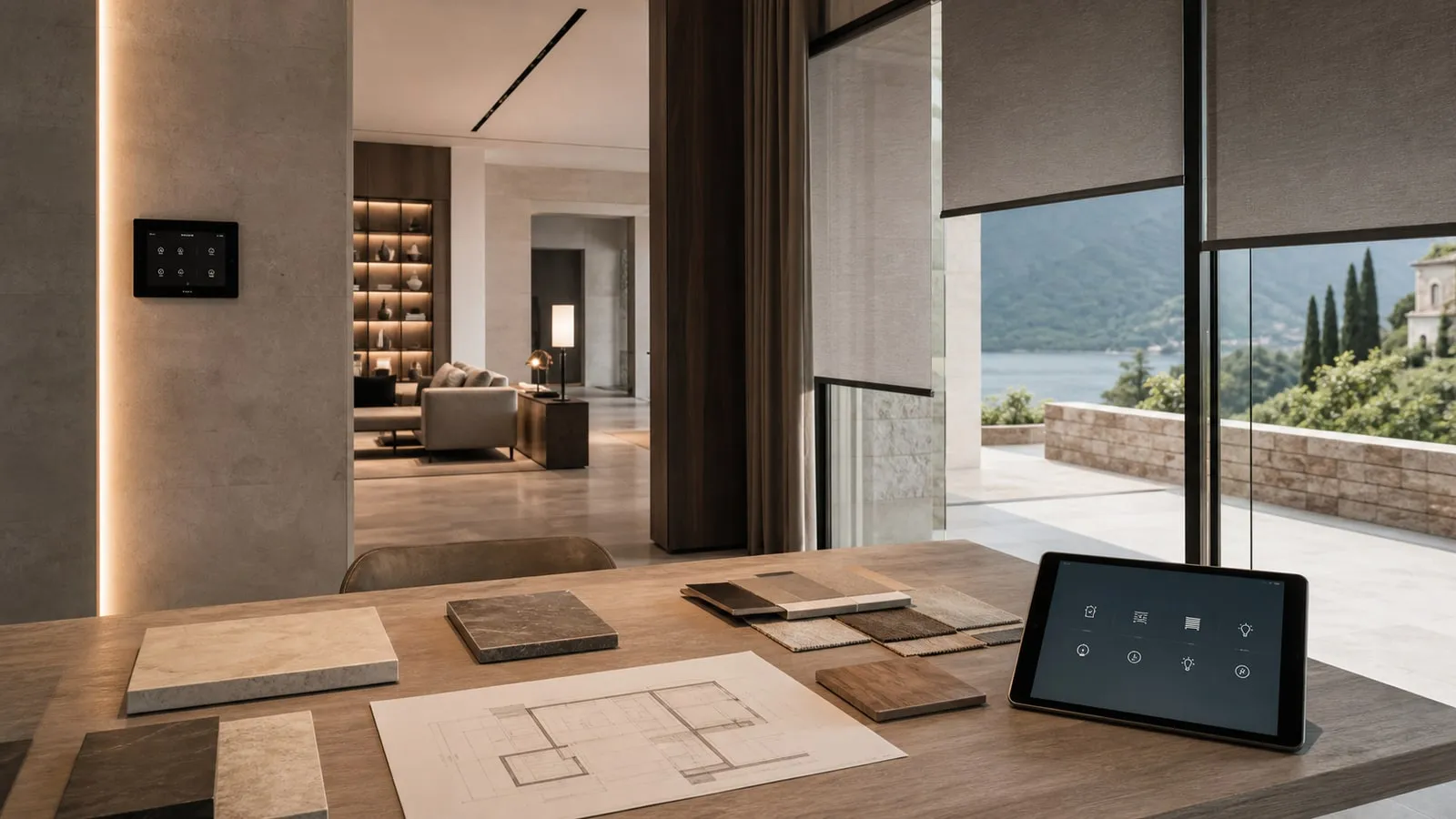
The first question from anyone evaluating a home automation system for a luxury villa is almost always the same: how much does it cost. It is a fair question, but also the hardest to answer without a project on the table. The price of a complete system depends on architectural choices, daily habits, the size of the property, the scenarios requested and the level of integration between technologies. A figure given without a site visit is little more than a guess.
What can be done, however, is to set realistic budget ranges. Not price lists, but orders of magnitude that help understand whether the client’s expectations and the project’s scope are aligned. This is useful for the owner, the architect and the property advisor alike, because it avoids two opposite risks: under-specifying a system for the value of the home, or spending heavily on features the client will never actually use.
What goes into the budget
A home automation system for a premium villa is not a single line item. It is the sum of several systems that often get confused at the early estimate stage.
The base system — control of lighting, climate, blinds and scenes — is the heart of the automation. On top of that you build multiroom audio, the integrated cinema room or living-room home theatre, video surveillance and access control, the structured network, the technical rack, the control interfaces (keypads, touch panels, app) and the integration with third-party systems such as the pool, irrigation, gates and private lifts.
Then come design, programming, commissioning, owner training and post-installation support. These are significant items and should never be compressed beyond a certain limit, because they make the difference between a system that genuinely works and one that remains a promise on paper.
Three realistic ranges for premium villas
For a lived-in villa in the premium segment, the investment ranges we see most often distribute roughly as follows.
Premium entry range — typically from 50,000 to 100,000 euros. This corresponds to a solid but essential automation system: lighting and climate control across the whole house, primary scenes, a multiroom audio zone covering three or four rooms, integrated intrusion detection, a properly designed data network. No dedicated cinema room, contained audio-video integration, automations designed to be easy to live with.
Full premium range — from 100,000 to 250,000 euros. This is the most typical range for villas between 400 and 700 square metres. It covers a complete KNX-based or equivalent automation system, multiroom audio extended to seven or ten zones, an integrated home cinema in the living area or a dedicated mid-level cinema room, professional video surveillance, access control, a well-sized technical rack and integration with pool, irrigation and gates.
Top tier — from 250,000 euros upwards, with villas above 700 square metres often exceeding 500,000 euros. This is the territory of reference-grade dedicated cinema rooms, high-end audio-video systems, full integration between automation and special systems, network redundancy and continuous support. The difference here is not the product itself but the technical direction and the quality of integration.
These figures do not include construction work, finishes, false ceilings, pre-wiring and base electrical systems, which always need to be accounted for separately.
What truly drives the final cost
For the same square footage, two villas can have very different quotes. The factors that weigh most are few and almost always the same.
The quality of the electrical and network pre-wiring comes first. If the cabling is already correct, properly sized and documented, the automation integration costs less and works better. If it has to be corrected during the build, the final cost can rise by as much as thirty per cent.
The number of third-party systems to be integrated comes second. A villa with a pool, a gym, a spa, a climate-controlled wine room, a private lift and an outdoor automation system requires a level of coordination and programming far above a home with few integrations. It is not the products that cost more, but the design and commissioning time.
The complexity of the requested scenarios is the third factor. A system with three main scenes is one thing. A system that manages arrival, dinner, night, holiday, guests, event mode, maintenance and a service-staff mode is a different job. Again, the cost is not in the devices but in the logic.
Mistakes that inflate the budget
There are not many, but they are common. The first is to choose the system before the project. The site work begins with a brand already locked in, only to discover it does not fit the architectural choices. The result is rework, costly integrations and compromises on control.
The second is fragmenting the suppliers. One contractor for the lights, another for the audio, another for security and no one coordinating the dialogue. This is the main source of hidden costs, because every later intervention has to rebuild a context that no one ever documented.
The third is underestimating programming and commissioning. A KNX or Control4 system is not a product you switch on and use. It needs hours of programming, real-scenario testing and owner training. Cutting corners here means having a system that technically works but that the owner will never use well.
How to start estimating
You do not need a detailed quote to begin. You need three things: the size and type of the property, the owner’s habits, and the desired level of integration. From these three elements an experienced integrator can propose a credible budget range and scope of work, to be refined later with a site visit and a proper design.
At NvisionGroup this preliminary phase is free of charge and is the moment when it becomes clear whether the project makes sense, whether the budget aligns with expectations and whether it is worth moving on to actual design. Elysium handles the systems side, Lastech the pre-wiring and infrastructure, Cinema in Casa the dedicated cinema rooms, and GTS Casa the property coordination when the villa is being purchased or renovated. It is a method that avoids both inflated quotes and optimistic ones that grow during construction.
Continue reading
Related articles on NvisionGroup:
- Mistakes to avoid when choosing a home automation system for a luxury home
- Control4, KNX and Matter: practical differences for a smart home
- KNX for premium smart homes: when it makes sense


