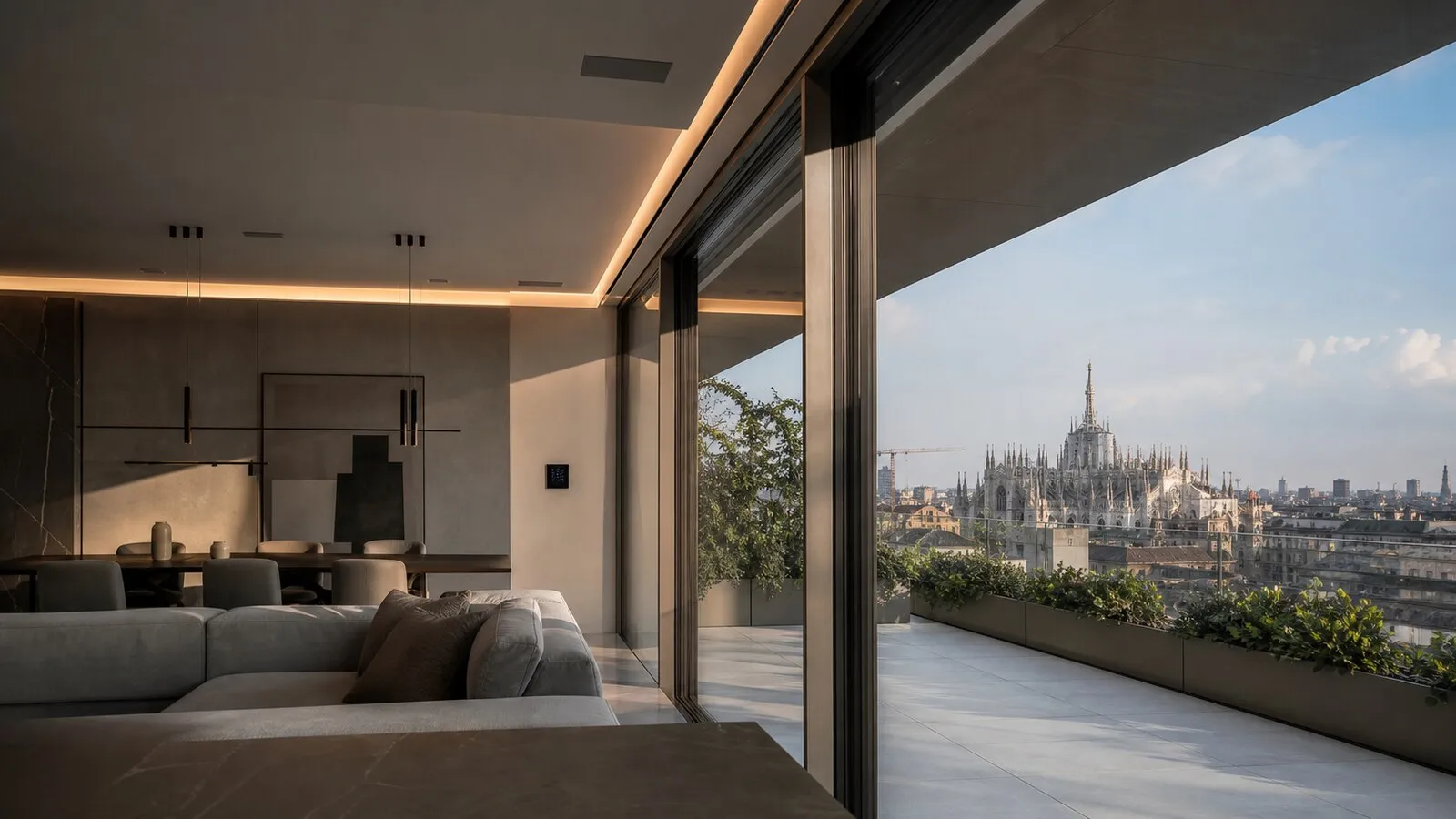
A Milan penthouse with integrated technology is not planned like a detached villa. Space is more constrained, building systems may interact with shared areas, cable routes are limited, terraces expose lighting and shading to weather, and comfort, privacy and security still need to match the standard of the property.
For international buyers, this difference matters early. The apartment may look complete during a viewing, but the future project may involve Italian designers, condominium procedures, local contractors, specialist installers and building managers. Technology should not arrive after the interior design is frozen. In a penthouse, every centimetre of ceiling, every floor build-up, every service void and every route to the terrace can decide whether automation, climate, network and AV are discreet or compromised.
The issue: integrating technology in constrained spaces
A penthouse is full of subtle trade-offs. It offers light, views, terrace life and prestige, but usually less technical freedom than a new independent villa. Available ceiling height may be limited. Existing risers may not be where new functions need them. Some walls and slabs may be difficult to chase. External units, ducts and terrace penetrations require careful planning.
This makes late technology decisions risky. A dimmable circuit, a motorized blind, a ceiling speaker or an outdoor camera needs a route, power, control and future access. If these points are missing from the technical plan, they can become visible devices, late openings or abandoned ideas.
The first question is practical: which functions belong to daily living? In a Milan penthouse, common priorities include architectural lighting, solar control, stable Wi-Fi, climate zoning, terrace management, entrance security, discreet music and physical controls that guests can understand without instructions.
Building rules, terraces and service routes
The condominium context requires coordination. Without providing legal advice, buyers should make sure the appointed professionals check any intervention that may affect shared areas, facade elements, roof spaces, risers, drains, exterior equipment or technical passages. The earlier this is discussed, the less likely the project is to clash with finished interiors.
The terrace is both a living room and a technical area. Lighting, sockets, speakers, blinds, pergolas, sensors, irrigation and security points need to withstand real use and remain accessible. A motorized shading system is not only a design feature: it needs power, control, safety logic and coordination with wind, sun and privacy.
Inside, service routes should be designed before finishes. If floors are specified before cable paths are known, or ceilings are shaped before speakers, lights and air outlets are positioned, the project loses precision. Lastech can support the technical reading of panels, lines, network and predispositions when feasibility depends on infrastructure.
Light, climate and shading at height
Natural light is one reason to choose a penthouse, but it must be controlled. Large glazing, multiple exposures and terraces can create glare, heat gain and privacy issues. Architectural lighting and motorized shading should be designed together, not as separate packages.
Useful scenes are based on real moments: morning, work, dinner, guests, night, terrace, away. A command near the entrance can lower selected blinds, reduce lighting, adjust climate and activate security functions. A keypad in the living area can move from service light to evening atmosphere without opening an app. The premium feeling is in the simplicity.
Climate needs the same discipline. High-level apartments with roof exposure and large glass can behave differently from room to room. Elysium can help coordinate thermostats, shading and user routines through automation, but the foundation must be a sound mechanical and electrical plan. Automation cannot fully repair a poor climate strategy.
Network, security and AV
A premium penthouse needs a professional network. Remote work, streaming, intercom, cameras, music, touchscreens and automation cannot depend on random router coverage. The project should include wired points where they matter, correctly placed access points and an organized rack or technical cabinet.
Security covers lift access, entrance door, terrace openings, secondary routes, intercom and remote management. The best project does not multiply apps and screens. It creates hierarchy: local controls for daily actions, supervision for richer functions and clear notifications for important events.
AV should be assessed realistically. A panoramic living room can host an elegant home theater, but glass, reflections, acoustics and furniture influence the result. If the buyer wants a true private cinema room, Cinema in Casa can evaluate a dedicated space or an integrated solution, coordinating blackout, speakers, acoustic treatment and scenes.
Checklist for a penthouse project
Before buying or renovating a Milan penthouse, confirm the sequence:
- Ask the appointed professionals to identify building, terrace, roof, riser and exterior-equipment constraints.
- Design technical routes before ceilings, floors and fixed joinery are finalized.
- Decide which shading, lighting and climate zones will be part of daily scenes.
- Plan wired network, access points, rack and data points for work, security and entertainment.
- Check acoustics, reflections and blackout before assuming a cinema or home theater will work.
- Keep documentation and maintenance responsibilities inside the project from the start.
GTS Casa helps the buyer read the property beyond the view and the finishes. When the project calls for it, the NvisionGroup companies can bring automation, systems and cinema expertise into the conversation before the most important technical choices disappear behind finished surfaces.
Continue reading
Related articles on NvisionGroup:
- Evaluating a villa before buying: technical signals to check
- Premium home renovation: systems, automation and finishes in one plan
- Single point of contact for a premium renovation: when it really helps


