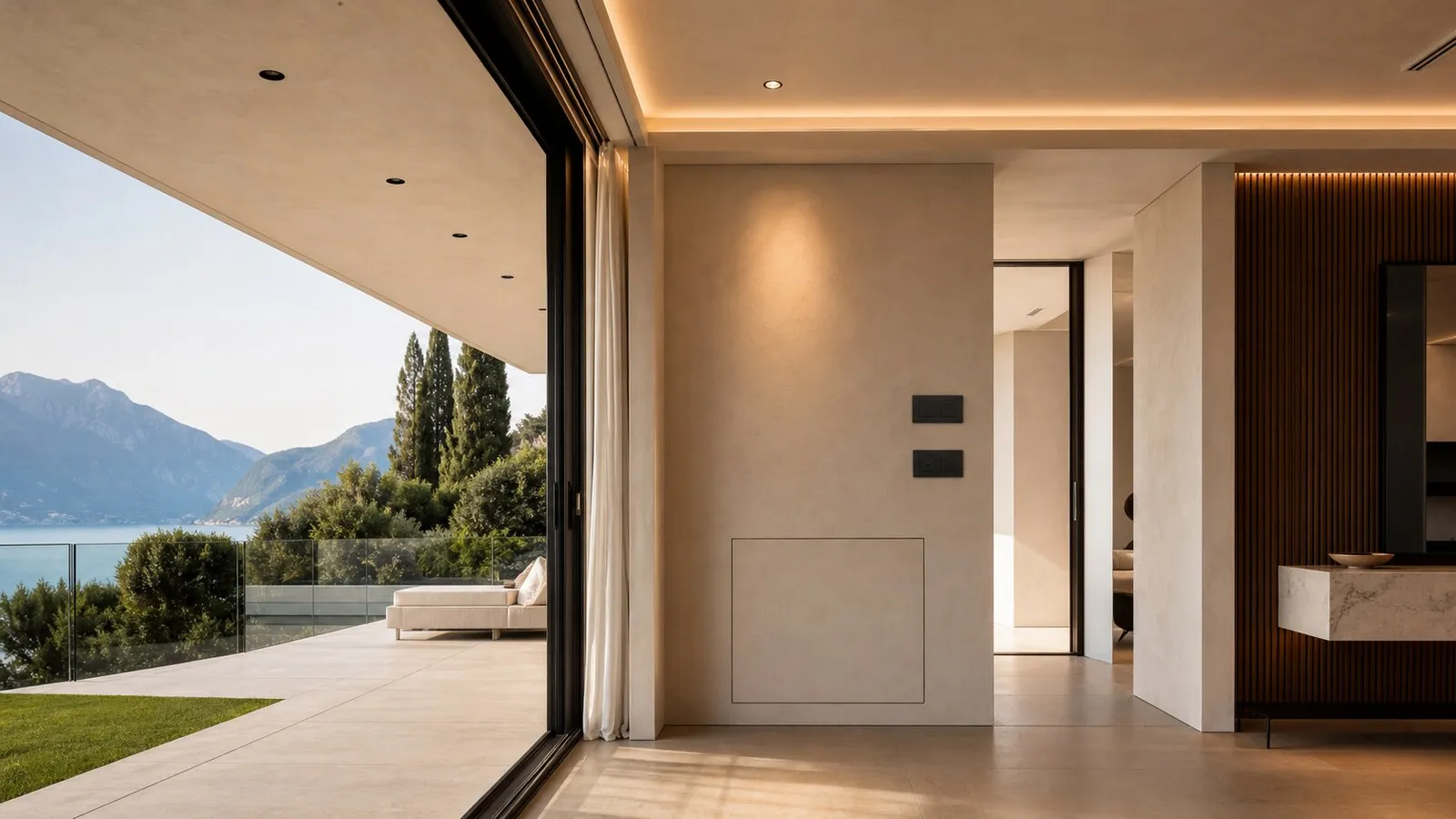
Evaluating a villa before buying is not only a matter of location, floor area, views and finishes. In a premium Italian property, much of the future living quality is hidden in electrical panels, cable routes, plant rooms, data networks, security systems, automation predispositions and the possibility of upgrading the home without undoing recent finishes.
This is especially important for international buyers. A viewing may last an hour, while the property will later need to support daily life, remote ownership, guests, staff, maintenance and periods of absence. A beautiful villa can still require significant technical work before it matches the way the buyer intends to live. The point is not to promise resale gains or offer investment advice. It is to understand whether the property, the planned use and the likely upgrade work belong to the same decision.
Why a beautiful villa can hide technical issues
The first impression is usually architectural: entrance, garden, materials, staircase, kitchen, terraces and light. But a residence is experienced through daily functions. The gate must open reliably. Pathways must be lit safely. Climate must be comfortable in real zones. Internet must work in bedrooms, office, pool area and guest spaces. Security must be clear. Audio, cinema and automation should feel calm rather than improvised.
During a viewing, separate what is actually installed from what is described in broad terms. “Ready for automation” may mean a documented wired system, or only a few empty conduits. “Video surveillance” may mean integrated IP cameras with proper recording, or standalone devices with unclear maintenance. “Recently renovated” does not automatically describe the quality of panels, labels, spare capacity and technical documentation.
Fragmentation is another common signal. A villa improved over many years may have separate systems for alarm, intercom, blinds, climate, garden lighting and Wi-Fi. That is not automatically wrong, but it changes the evaluation. Later integration may be straightforward, limited or expensive depending on wiring, brands, component age and physical access.
Systems, panels and plant room
The plant room tells a lot about the property. Look for organized space for electrical panels, network rack, control units, power supplies, security equipment and future expansion. A cramped or improvised technical area can make every later intervention more invasive. Location also matters: a rack far from real cable routes or a panel with poor access can slow maintenance.
Electrical panels deserve attention. Labels, spare space, protected supplies, separation between power and signal, service loops and general order are useful signals. The buyer does not need to perform a full technical inspection during the first visit, but should understand whether the property appears to have been planned as a system or assembled in layers.
Climate control also needs a specific reading. Villas with large glazing, lofted rooms, basements, guest wings, wellness areas and outdoor living spaces need zones that match real use. A house may look refined and still be difficult to manage room by room. If the buyer expects remote control, seasonal management or different temperatures for guests and owners, those expectations should be checked before the offer becomes emotionally fixed.
Network, security and smart predispositions
Data network is primary infrastructure. Thick masonry, reinforced concrete, multiple floors, gardens, pool houses and garages can all weaken a consumer Wi-Fi setup. A premium villa should be assessed for wired network points, access point positions, rack quality, outdoor coverage and the possibility of remote support.
Security should be read in layers: perimeter, doors, gates, garage, alarm, cameras, intercom, notifications and user permissions. The goal is not to count devices. It is to understand whether the system is coherent, documented and maintainable. A non-integrated alarm can still be robust. A poorly integrated system can create confusion across apps, codes and responsibilities.
For automation, the right question is not whether there is an app. Ask which functions are wired, which are wireless, which work locally, which depend on cloud services and which can be used easily by guests or house staff. Elysium can support this level of evaluation when the future owner wants lighting scenes, blinds, climate, audio and interfaces to work as one environment.
Spaces for cinema, audio and automation
Buyers who want a private cinema room, a living-room theater or distributed audio should verify feasibility before purchasing. Not every spare room is suitable. Proportions, ceiling height, adjacent rooms, exterior noise, windows, blackout possibilities, cable routes and rack position all influence the result.
Cinema in Casa can later assess whether a room can host screen, speakers, acoustic treatment, seating, scenic lighting and integrated control without forcing the architecture. For the buyer, this information matters early. It separates a property that can absorb the project cleanly from one that may require broader building work.
The same applies to multiroom audio and outdoor areas. Terrace, pool, kitchen, gym, study and bedrooms all have different needs. If there are no accessible routes or inspection points, adding speakers and controls after purchase can be more invasive than expected.
Checklist before making an offer
Before making an offer, create a technical picture of the property:
- Request available documentation for electrical systems, automation, network, security and recent maintenance.
- Check panels, plant room, rack, cable routes and spare capacity for future work.
- Separate documented predispositions from generic statements made during the visit.
- Identify which systems are already integrated and which would need later coordination.
- Assess possible rooms for cinema, audio, office or wellness against noise, wiring and blackout needs.
- Connect technical gaps to an upgrade budget without treating them as guaranteed value growth.
GTS Casa helps buyers read the property beyond the first impression and, when useful, coordinate specialist input from the NvisionGroup companies. For an international buyer considering a villa in Italy, this turns the viewing from a visual tour into a more reliable decision process.
Continue reading
Related articles on NvisionGroup:
- Milan penthouse with integrated technology: what changes in the project
- Premium home renovation: systems, automation and finishes in one plan
- Single point of contact for a premium renovation: when it really helps


